
Meydan LabSystems and Computational Biomedicine · Weill Cornell Medicine

Media archive

Newspapers, magazines, broadcasters and space agencies have covered studies coauthored by Dr. Meydan. The topics include astronauts, city microbiomes, the pandemic and cancer.

109stories
58outlets
20national & international outlets
11studies
2013–2026years of coverage

Coverage includes

Coverage by study

Primary work

SWI/SNF & 3D genomeNature · 2026

SWI/SNF complexes shape 3D chromatin architecture through CTCF and cohesin

Shows how SWI/SNF chromatin remodelers shape 3D genome architecture through CTCF and cohesin, giving a unifying explanation for how some of the most common cancer mutations fuel tumor growth.

Weill Cornell MedicineOct 28, 2026Press release

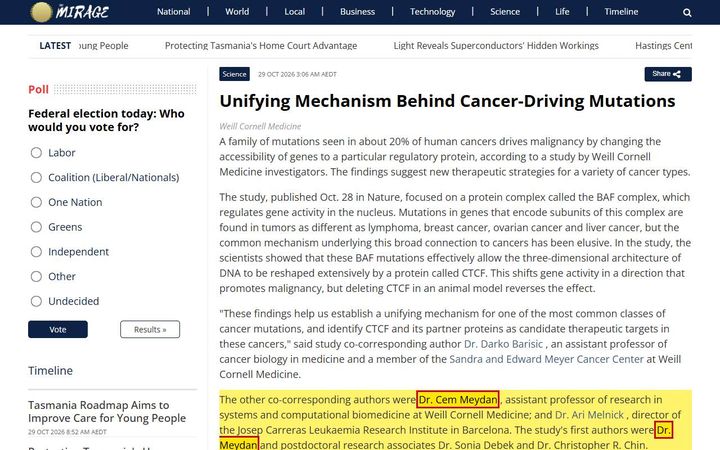
A Unifying Mechanism for Cancer-Driving Mutations

Release on a Nature study showing that BAF-complex mutations, found in about 20% of cancers, work by letting CTCF reshape 3D genome architecture; deleting CTCF in an animal model reverses the effect.

The other co-corresponding authors were Dr. Cem Meydan, assistant professor of research in systems and computational biomedicine at Weill Cornell Medicine; and Dr. Ari Melnick, director of the Josep Carreras Leukaemia Research Institute in Barcelon…
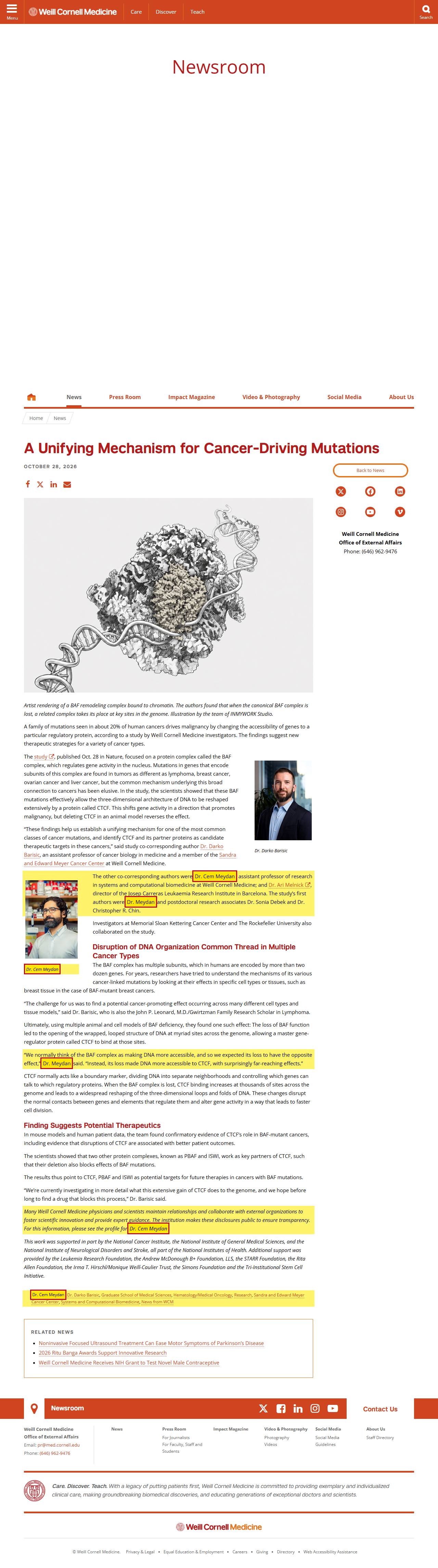
Passage on the Weill Cornell Medicine page
Mirage NewsOct 2026

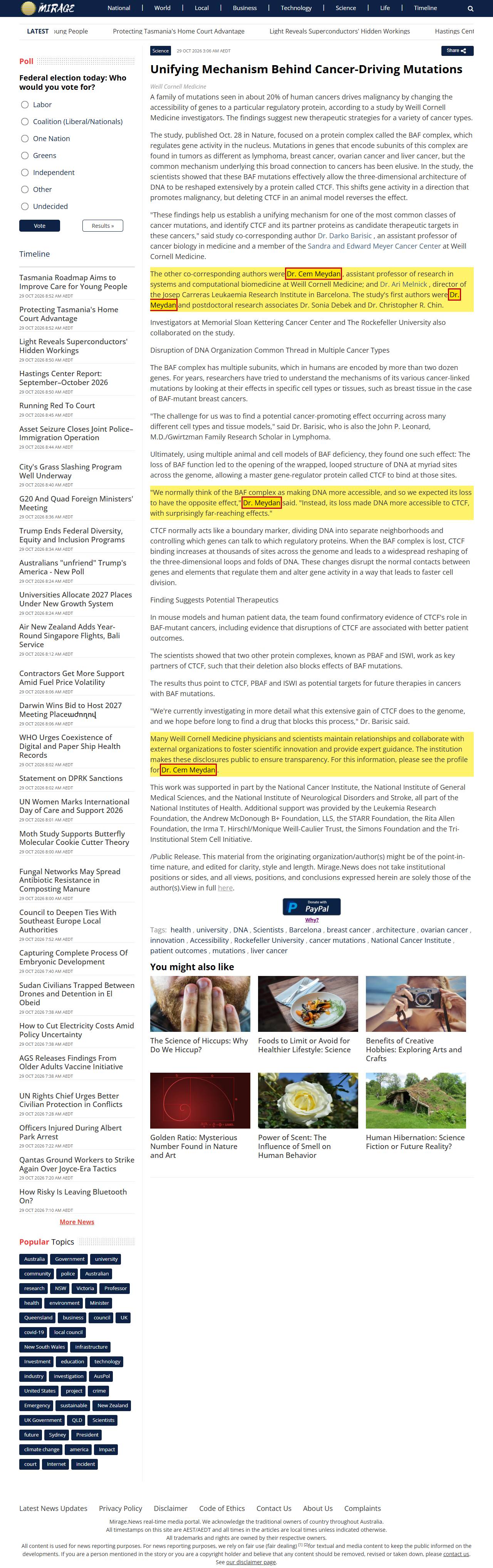
Unifying Mechanism Behind Cancer-Driving Mutations

Reprint of the release describing how BAF mutations, present in roughly one fifth of cancers, let CTCF extensively remodel DNA's 3D structure, a shift reversed by deleting CTCF in an animal model.

The other co-corresponding authors were Dr. Cem Meydan , assistant professor of research in systems and computational biomedicine at Weill Cornell Medicine; and Dr. Ari Melnick , director of the Josep Carreras Leukaemia Research Institute in Barcel…
Passage on the Mirage News page
Cancer Cell cover
ARID1A & lymphomaCancer Cell · 2024

ARID1A orchestrates SWI/SNF-mediated sequential binding of transcription factors with ARID1A loss driving pre-memory B cell fate and lymphomagenesis

Shows how ARID1A loss reprograms B cell fate in follicular lymphoma and leaves these tumors vulnerable to BAF inhibitors already in clinical trials.

Weill Cornell MedicineMar 2024Press release

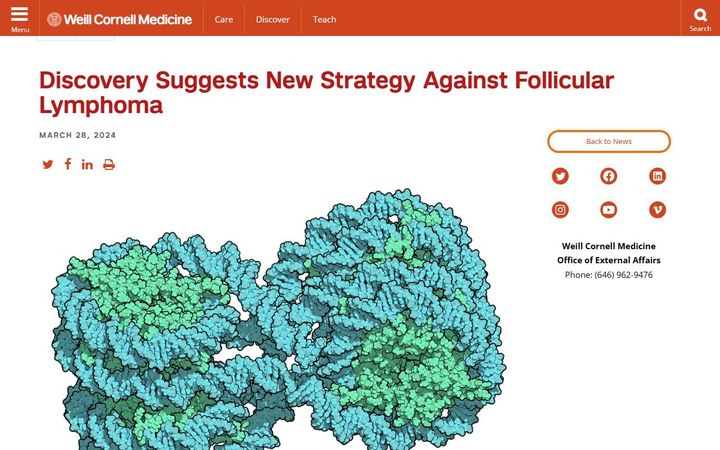
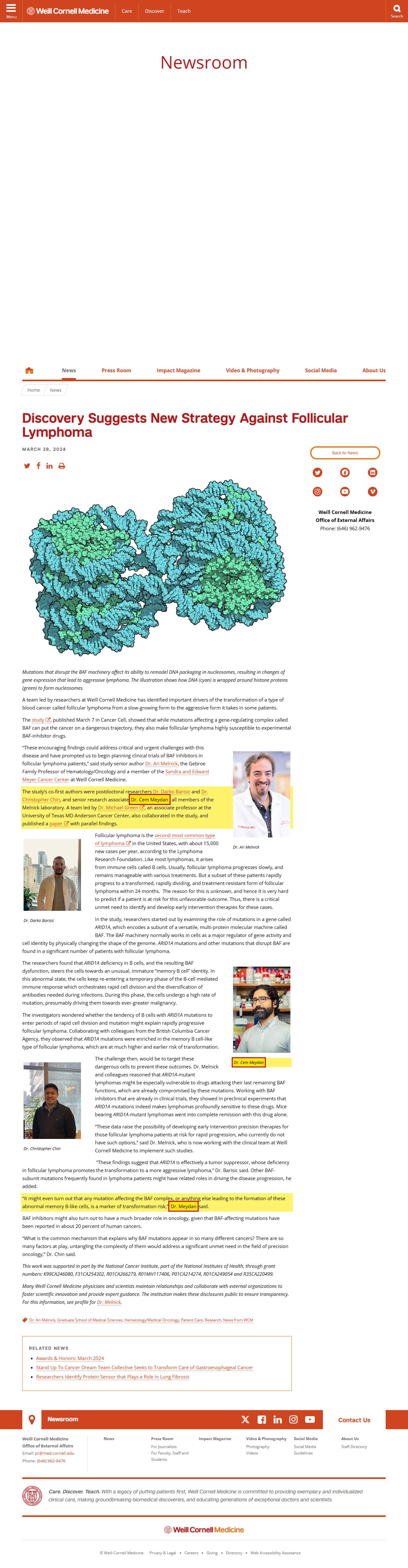
Discovery Suggests New Strategy Against Follicular Lymphoma

Release on a Cancer Cell study identifying BAF-complex mutations as drivers of follicular lymphoma transformation to aggressive disease, while also making it sensitive to experimental BAF inhibitors; trials are being planned.

The study’s co-first authors were postdoctoral researchers Dr. Darko Barisic and Dr. Christopher Chin, and senior research associate Dr. Cem Meydan, all members of the Melnick laboratory. A team led by Dr. Michael Green, an associate professor at the University of Texas MD Anderson Cancer Center, also collaborated in the study, and publish…
Passage on the Weill Cornell Medicine page
Josep Carreras Leukaemia Research Institute2025Talk

Seminar: Integrative epigenomics of SWI/SNF driven 3D genome rewiring (Dr. Cem Meydan)

Event listing for a seminar on SWI/SNF-driven 3D genome rewiring, with a speaker biography covering his single-cell, spatial and 3D epigenomic work on blood cancers.

Dr. Cem Meydan is an Assistant Professor of Computational Biology at Weill Cornell Medicine. He uses single cell, spatial, and 3D epigenomic profiling to map the gene-regulatory circuits that drive hematologi…
Passage on the Josep Carreras Leukaemia Research Institute page
Medical XpressMar 2024

Discovery suggests new strategy against follicular lymphoma

Reprint of the release on drivers of follicular lymphoma turning aggressive; BAF mutations raise risk but make the cancer highly susceptible to BAF inhibitors, and a parallel study reached similar findings.

The study's co-first authors were postdoctoral researchers Dr. Darko Barisic and Dr. Christopher Chin, and senior research associate Dr. Cem Meydan, all members of the Melnick laboratory. A team led by Dr. Michael Green, an associate professor at the University of Texas MD Anderson Cancer Center, also collaborated in the study, and publish…
Passage on the Medical Xpress page

1 more

Pharmacy TimesMar 2024Study: Mutation Found to Make Follicular Lymphoma More Susceptible to Experimental Drug

Trade summary of a Cancer Cell study finding that BAF mutations can drive follicular lymphoma progression yet increase sensitivity to experimental BAF inhibitors, with clinical trials in planning.

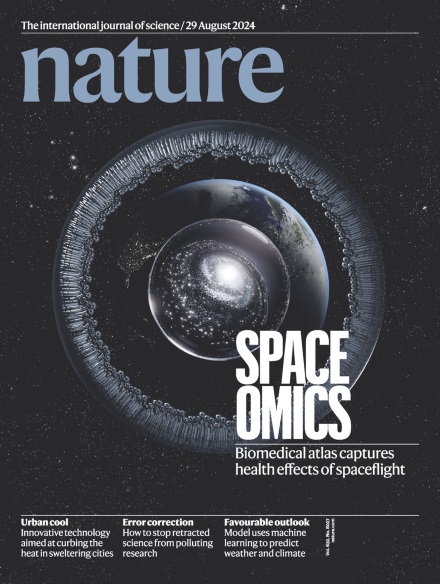
Nature cover
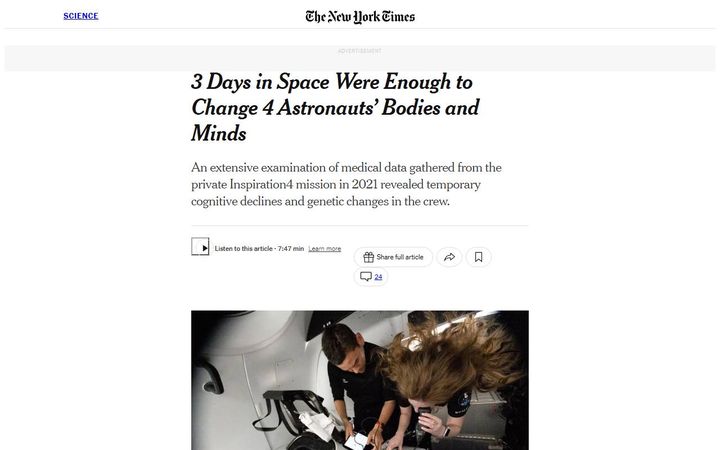
SOMA / Inspiration4Nature · 2024

The Space Omics and Medical Atlas (SOMA) and international astronaut biobank

The largest release of biomedical data from astronauts, built from the civilian Inspiration4 crew: three days in orbit left measurable, mostly reversible changes. Covered by The New York Times, Science, Space.com and National Geographic, and hosted as an open atlas and biobank.

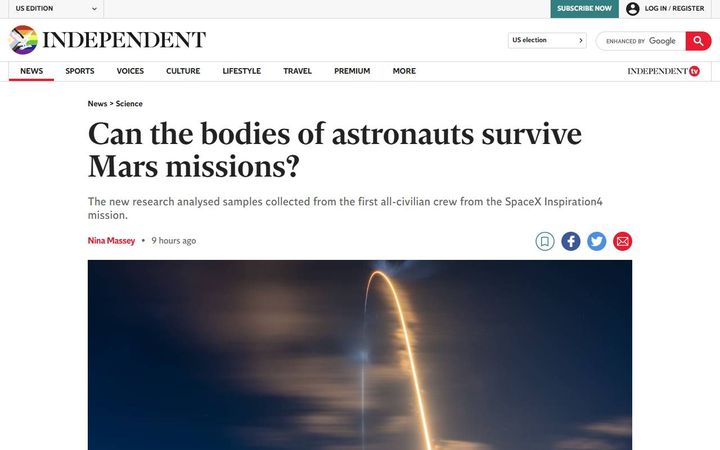
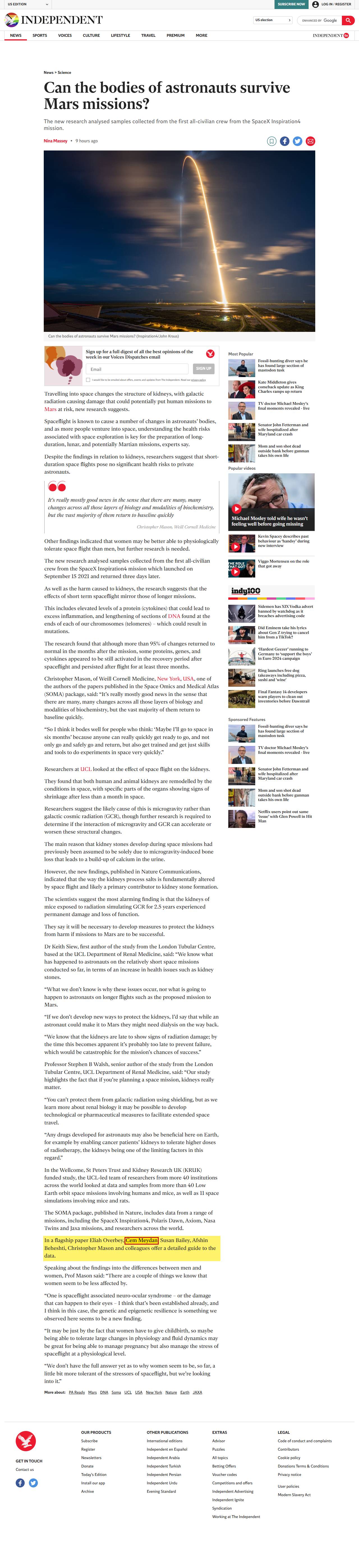
The IndependentJun 11, 2024

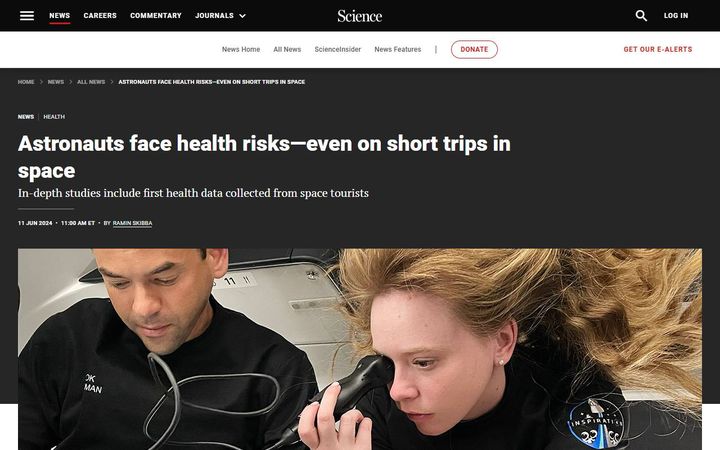
Can the bodies of astronauts survive Mars missions?

Original article on the Inspiration4-based SOMA atlas, reporting kidney structural changes from space radiation, mostly quick-to-recover changes, no major risk from short flights, and hints that women tolerate flight better.

In a flagship paper Eliah Overbey, Cem Meydan, Susan Bailey, Afshin Beheshti, Christopher Mason and colleagues offer a detailed guide to the data.
Passage on the The Independent page

10 more

NatureJun 11, 2024Space Omics and Medical Atlas (SOMA) across orbits (immersive)Interactive

Nature's interactive feature presenting the Space Omics and Medical Atlas, a compendium of data, protocols and code from over 100 institutions, including samples from the first all-civilian orbital crew.

Cem Meydan, Weill Cornell Medicine, Meydan Lab
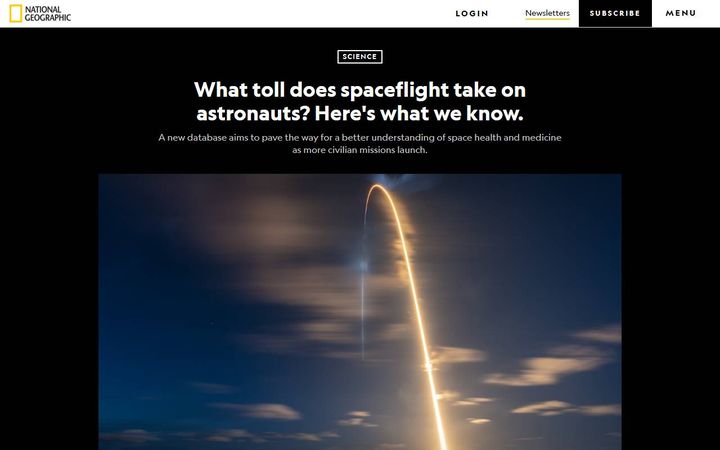
National GeographicJun 2024What toll does spaceflight take on the human body?

Describes the June 2024 package of 44 papers in Nature journals, drawing on four civilian Inspiration4 crew, that builds a baseline for understanding how spaceflight affects human biology beyond professional astronauts.

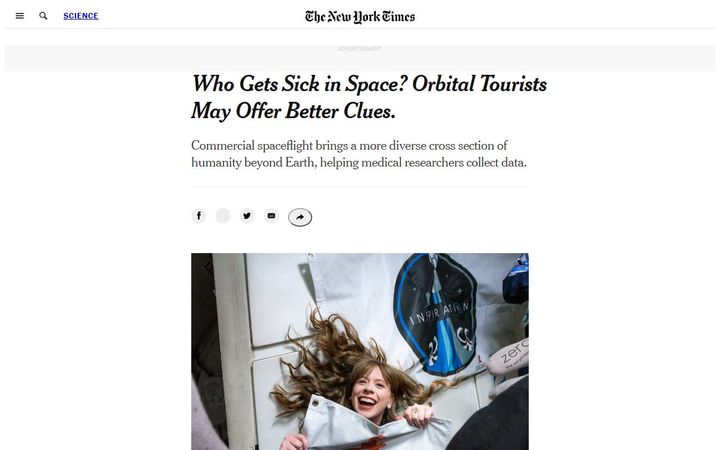
The New York TimesSep 16, 2021Who Gets Sick in Space? Inspiration4 May Offer More Clues.

Pre-launch era reporting on how commercial spaceflight, with a more diverse set of travelers, will give medical researchers new data on how the human body adapts to space, framed around Inspiration4.

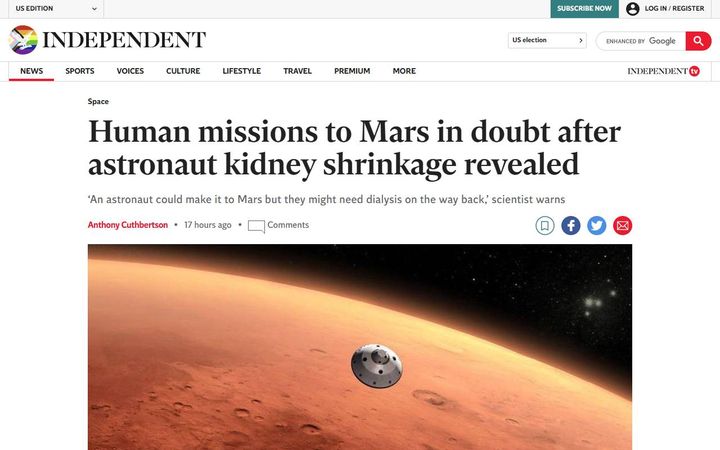
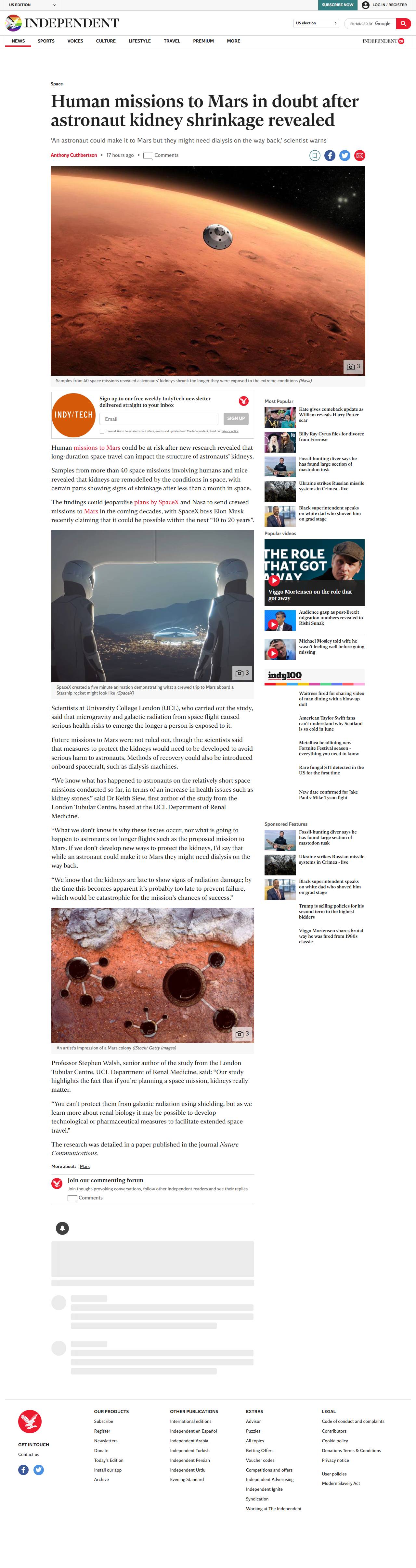
The IndependentJun 12, 2024Human missions to Mars in doubt after astronaut kidney shrinkage revealed

Rewritten UK-focused article on kidney findings from over 40 human and mouse missions, with UCL researchers warning of kidney shrinkage after under a month in space and possible Mars risks.

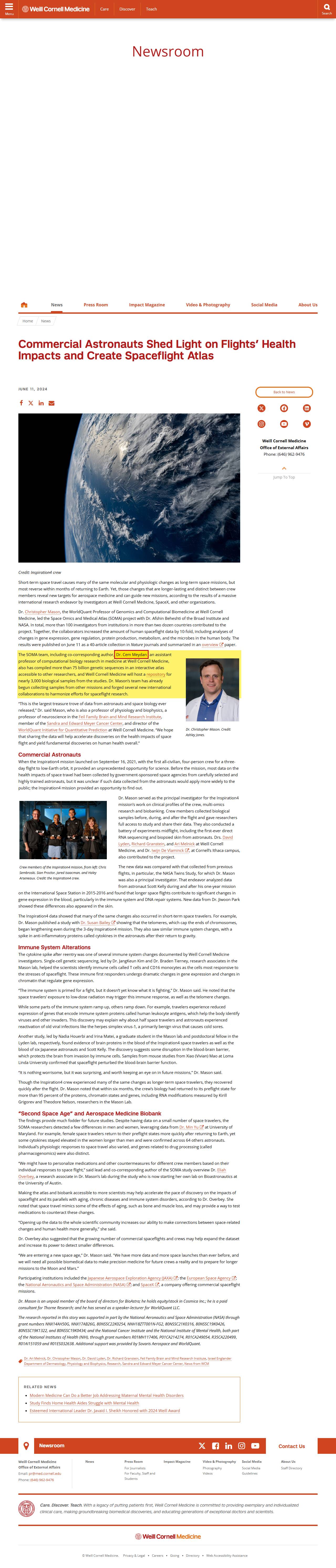
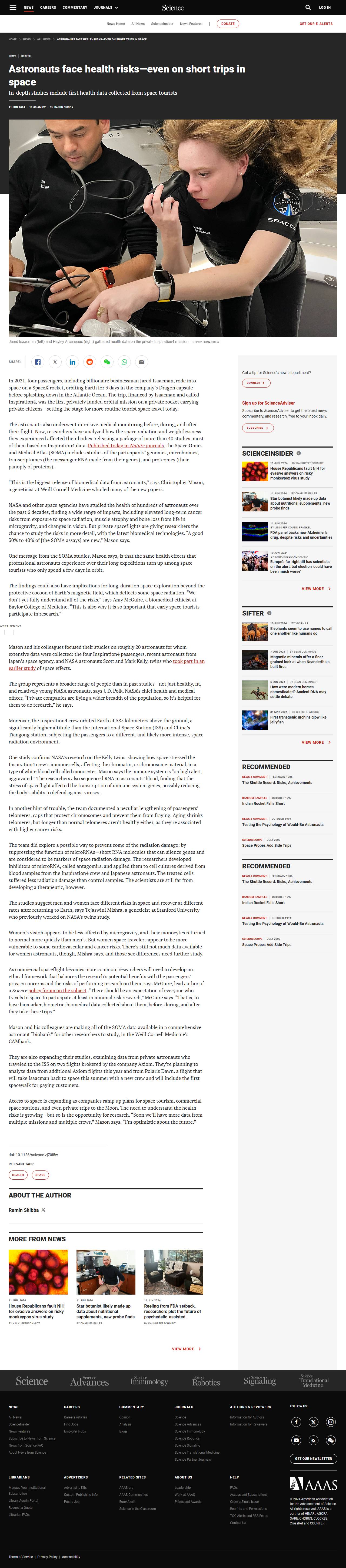
Weill Cornell MedicineJun 11, 2024Commercial Astronauts Shed Light on Flights' Health Impacts and Create Spaceflight AtlasPress release

Release saying short-term spaceflight causes many molecular and physiologic changes of long missions, mostly reversing within months, and announcing a large multi-institution atlas with over 75 billion sequences and a biobank of nearly 3,000 samples.

The SOMA team, including co-corresponding author, Dr. Cem Meydan, an assistant professor of computational biology research in medicine at Weill Cornell Medicine, also has compiled more than 75 billion genetic sequences in an interactive atlas accessible to o…
Passage on the Weill Cornell Medicine page
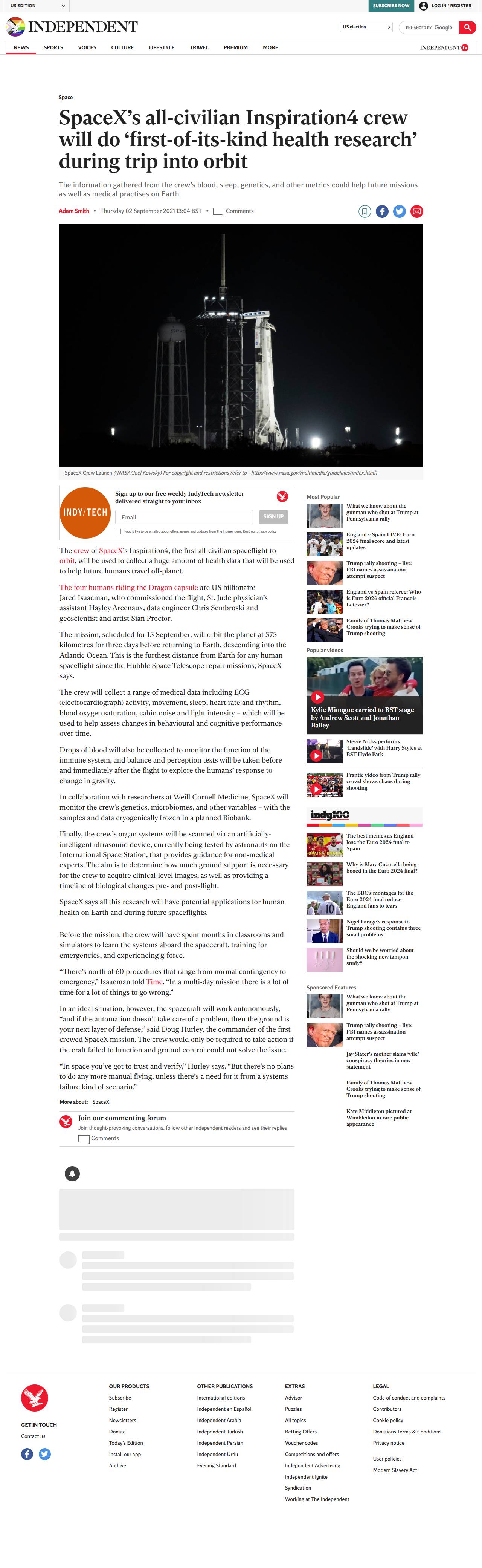
The IndependentSep 2021SpaceX's Inspiration4 crew will do 'first-of-its-kind health research' during trip into orbit

Previews the Inspiration4 crew's planned health research, with blood, sleep and genetic data gathered on the three-day orbital trip to inform future missions and medicine on Earth.

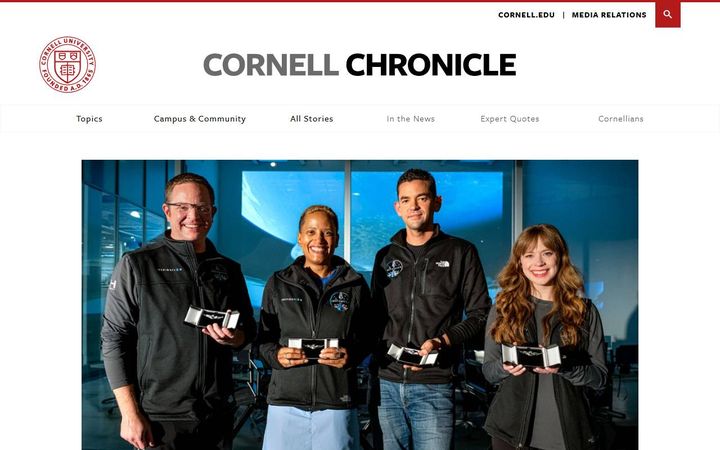
Cornell ChronicleJun 11, 2024Commercial astronauts shed light on flights' health impactsPress release

University news story reporting that brief commercial spaceflight reproduces many long-mission molecular changes that mostly reverse after return, and that the team built a shared atlas and sample repository.

The SOMA team, including co-corresponding author, Cem Meydan, an assistant professor of computational biology research in medicine at Weill Cornell Medicine, also has compiled more than 75 billion genetic sequences in an interactive atlas accessible to o…
Passage on the Cornell Chronicle page
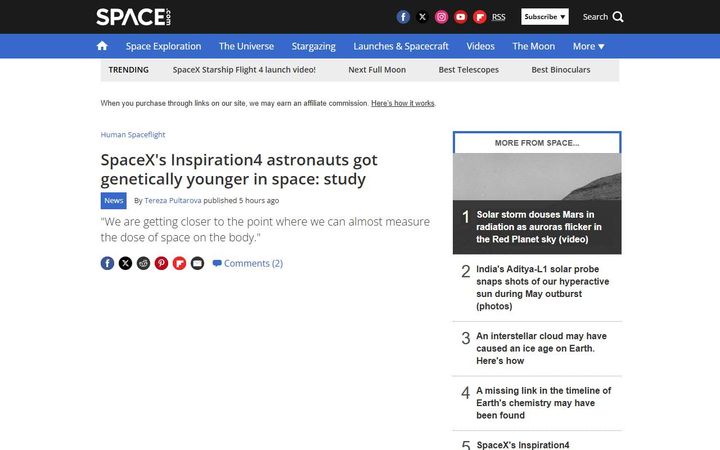
Space.comJun 11, 2024SpaceX's Inspiration4 astronauts got genetically younger in space: study

Reports that the four Inspiration4 crew appeared genetically younger in some measures during the three-day flight, but briefly, as three papers detailed fast, profound effects of space on the body.

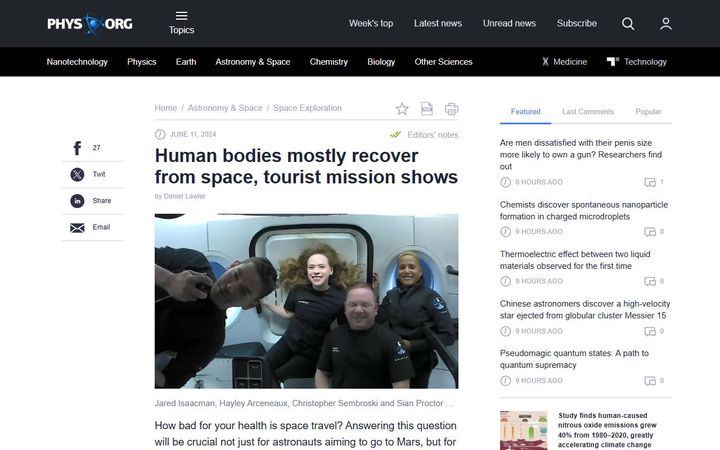
Phys.org (AFP)Jun 11, 2024Human bodies mostly recover from space, tourist mission shows

AFP report on dozens of papers using data from four SpaceX tourists, finding that spaceflight changes bodies in many ways but most changes revert within months after returning to Earth.

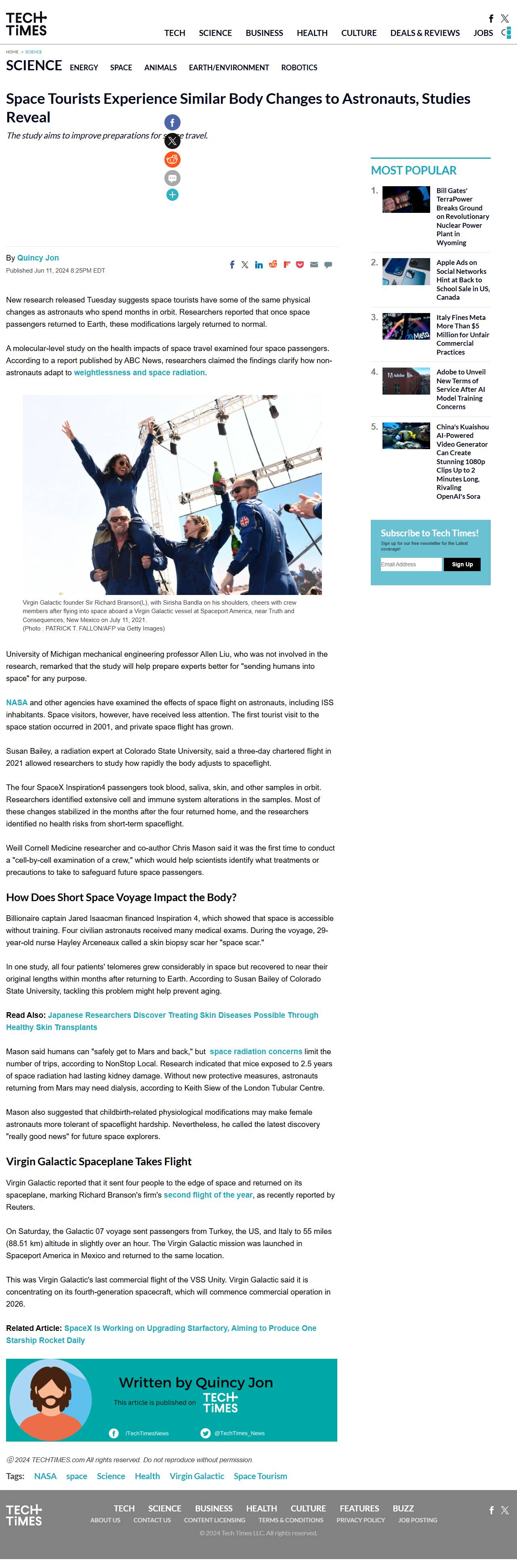
Tech TimesJun 11, 2024Space Tourists Experience Similar Body Changes to Astronauts, Studies Reveal

Reports that short-duration space tourists showed some of the same physical changes seen in long-stay astronauts, which largely resolved after return; cites an outside expert on implications for future missions.

COVID-19

Cell Reports Medicine · 2022System-wide transcriptome damage and tissue identity loss in COVID-19 patients

Nature Communications · 2021Shotgun Transcriptome, Isothermal, and Spatial Omics Profiling of SARS-CoV-2 Infection

Rapid isothermal tests, host-response and spatial profiling, and the COVID Genes resource built during the first waves of the New York City outbreak.

11 more

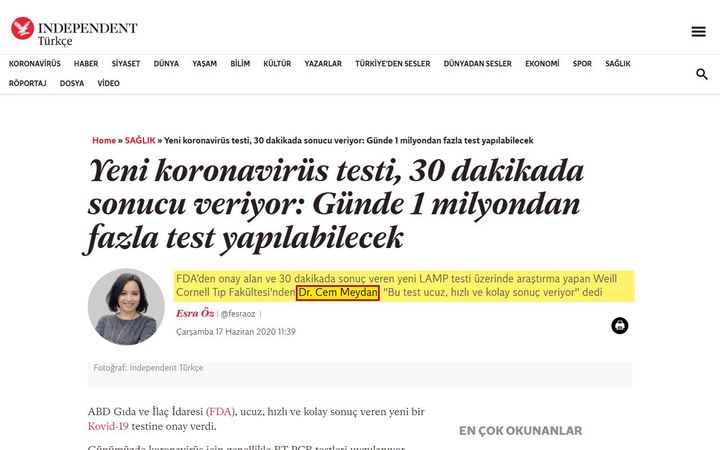
The Independent (Turkish edition)2020New coronavirus test gives results in 30 minutesIn Turkish

Turkish-language article on an FDA-authorized LAMP COVID-19 test that is cheap and returns results in about 30 minutes without special equipment, tied to subway microbiome mapping work in New York.

Dr. Cem Meydan of Weill Cornell Medicine, who works on the LAMP test, said the new test shows within 30 minutes whether the virus is present.
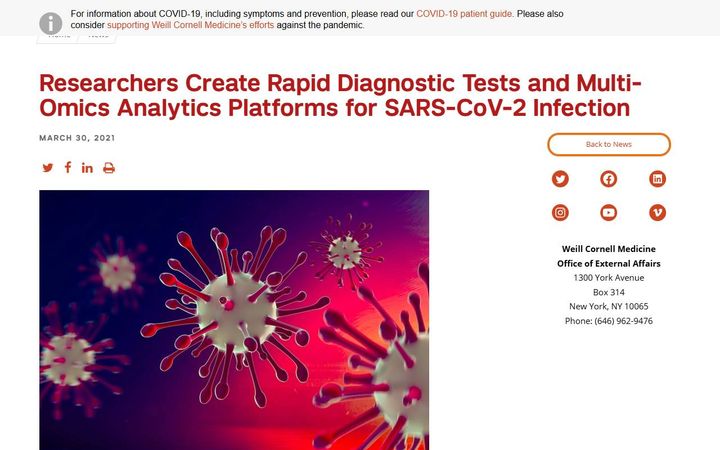
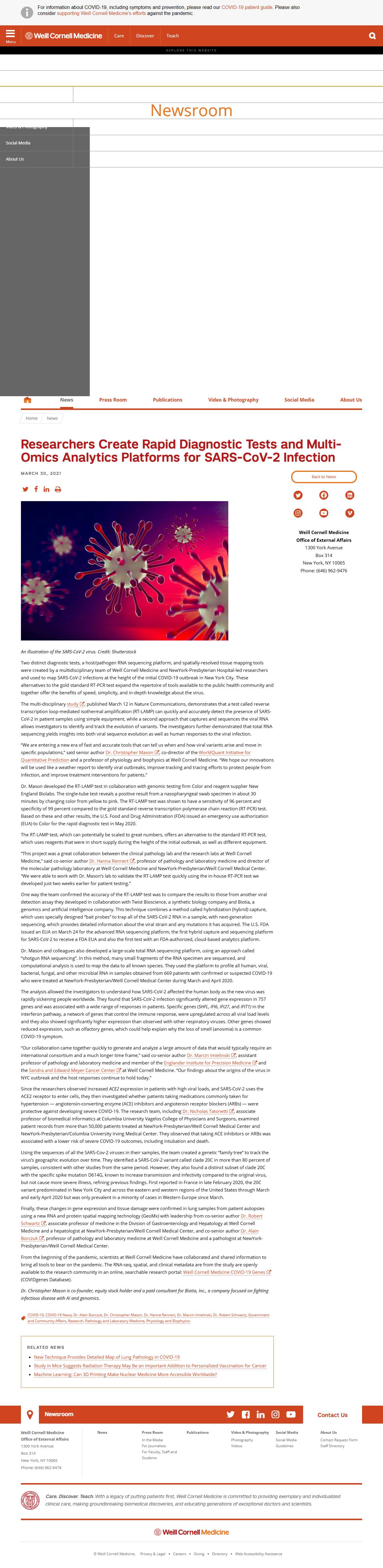
Weill Cornell MedicineMar 2021Researchers Create Rapid Diagnostic Tests and Multi-Omics Analytics Platforms for SARS-CoV-2 InfectionPress release

Release on a Nature Communications study presenting two rapid diagnostic tests, an RNA sequencing host/pathogen platform and spatial tissue mapping as alternatives to RT-PCR, used to map early New York infections.

Weill Cornell MedicineMay 2020Weill Cornell Medicine Tackles COVID-19Press release

Institutional overview of Weill Cornell and NewYork-Presbyterian COVID-19 research, including work to map virus hot spots and other basic and translational projects launched in the first months of the pandemic.

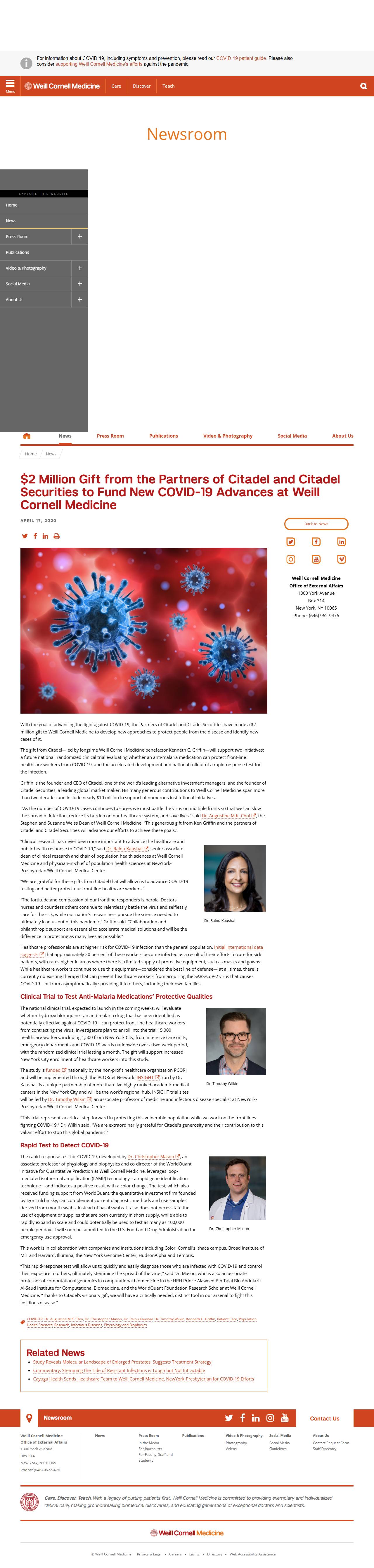
Weill Cornell MedicineApr 2020$2 Million Gift from the Partners of Citadel and Citadel Securities to Fund New COVID-19 AdvancesPress release

Weill Cornell announcement of a $2 million Citadel gift to fund a trial of an antimalarial drug for protecting health workers and the rollout of a rapid COVID-19 test.

IEEE Spectrum2020Swabbing the World's Cities for Coronavirus

Describes how MetaSUB researchers swab transit kiosks, benches and other surfaces in cities worldwide to detect SARS-CoV-2 and build models that could give early warning of outbreaks, including a 15-city effort.

Cornell ChronicleMar 2021Researchers create rapid tests, analytics for COVID-19Press release

Describes a Nature Communications study from Weill Cornell and NewYork-Presbyterian presenting RT-LAMP and viral RNA capture sequencing as alternatives to RT-PCR, plus RNA sequencing and spatial tissue mapping of SARS-CoV-2.

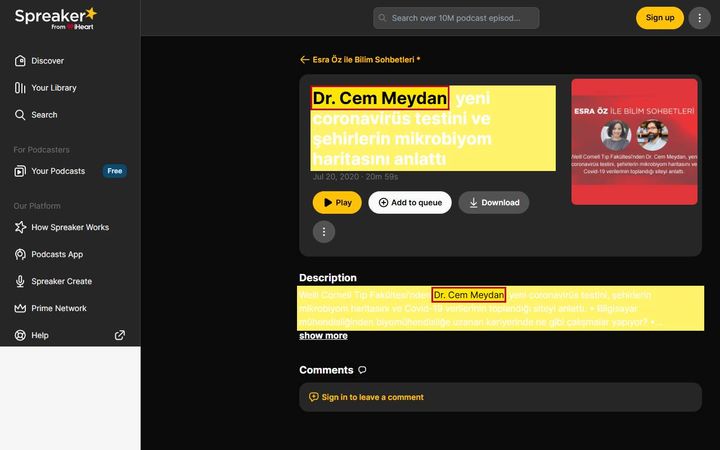
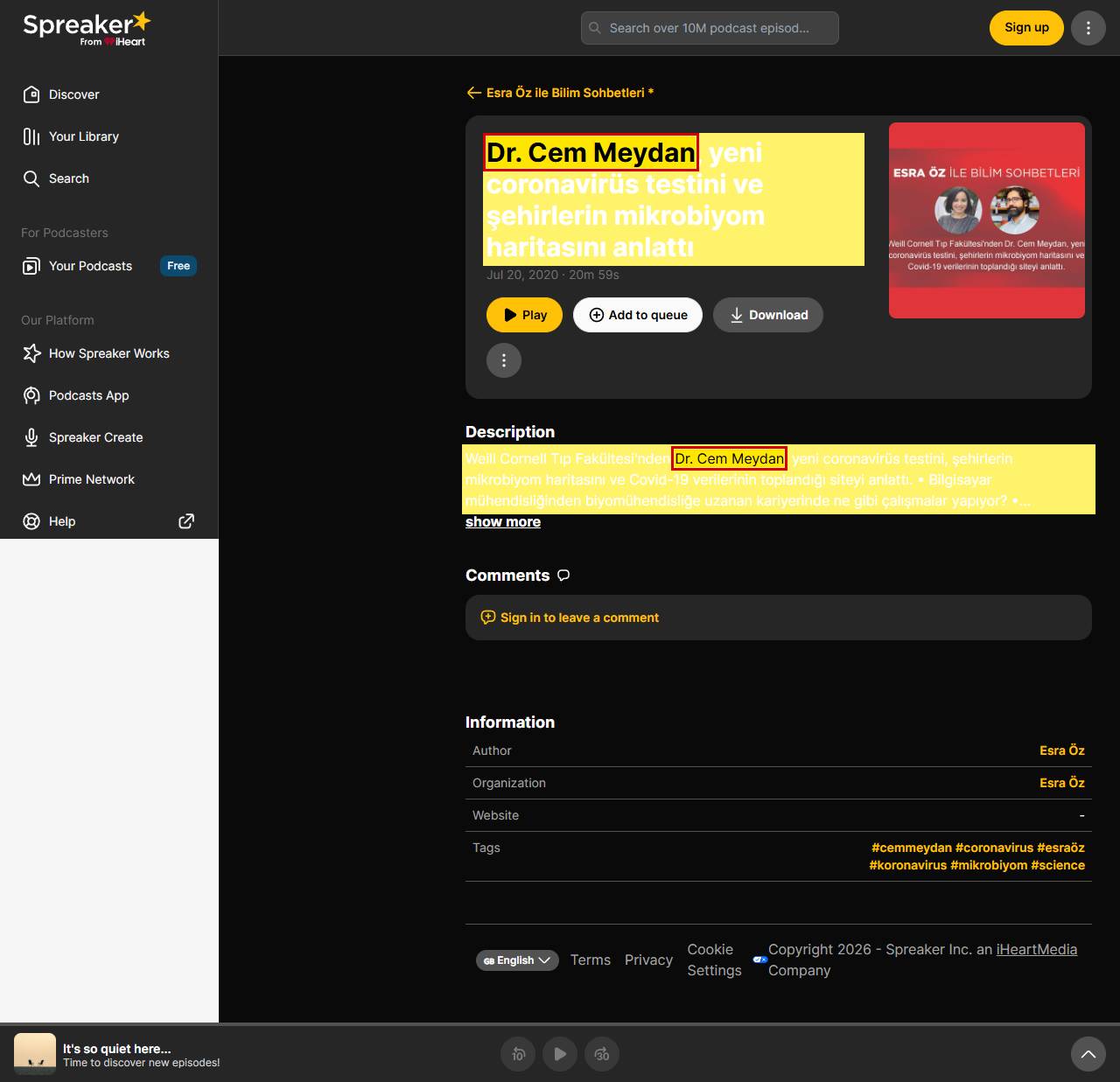
Podcast (Spreaker)2020Dr. Cem Meydan on the new coronavirus test and microbiome maps of citiesPodcastIn Turkish

Turkish-language podcast episode describing a new coronavirus test, the city microbiome map project, and a site collecting COVID-19 data.

Dr. Cem Meydan of Weill Cornell Medicine described the new coronavirus test, the microbiome map of cities, and a site that collects COVID-19 data.
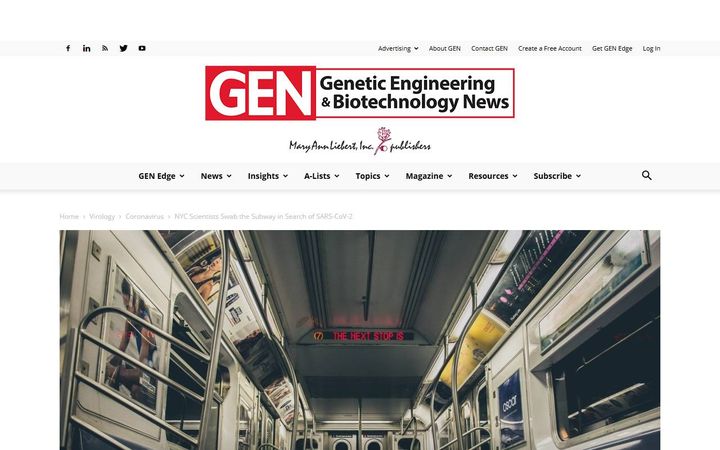
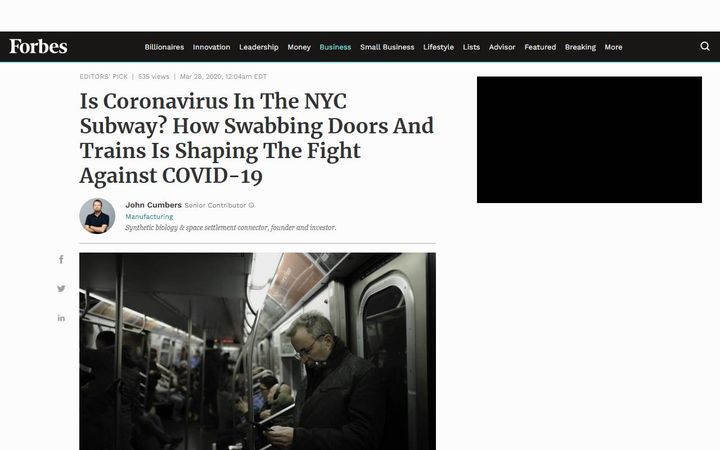
GEN (Genetic Engineering & Biotechnology News)2020NYC Scientists Swab the Subway in Search of SARS-CoV-2

Covers New York scientists swabbing the subway for SARS-CoV-2 as part of the MetaSUB consortium, and the idea of tracking viral presence in the city's shared built environment.

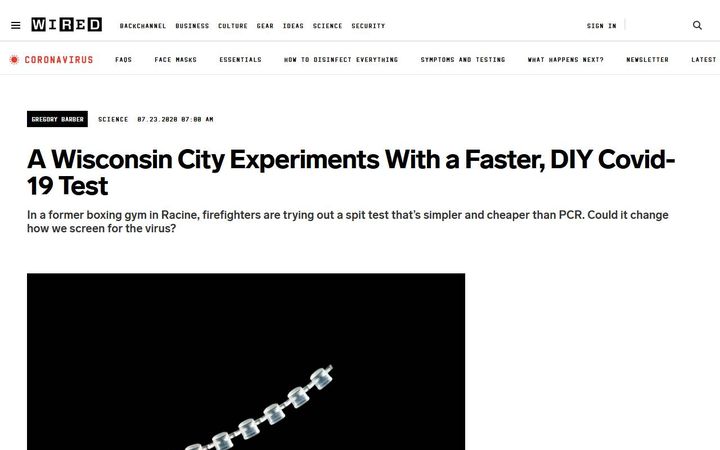
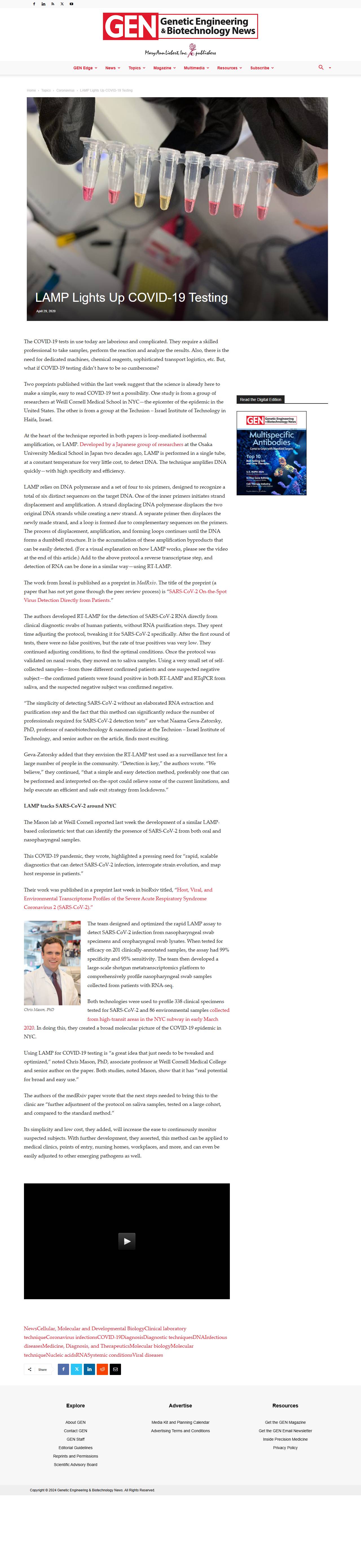
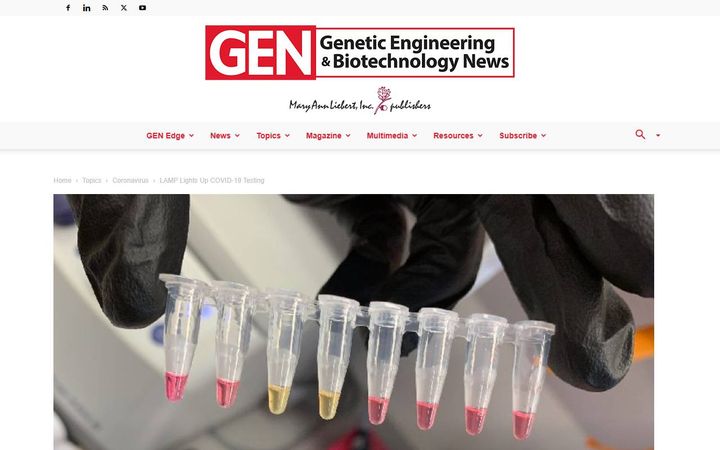
GEN (Genetic Engineering & Biotechnology News)2020LAMP Lights Up COVID-19 Testing

Reports two preprints, one from Weill Cornell and one from the Technion, showing LAMP can give a simple, inexpensive, single-tube COVID-19 test, and explains how the method works.

Genetic Literacy ProjectMay 5, 2020'Microbe maps': Swabbing subways, ATMs and park benches to find coronavirus hot spots

Genetic Literacy Project piece on 'microbe maps': swabbing subways, ATMs and park benches to locate coronavirus hot spots in New York (archived copy).

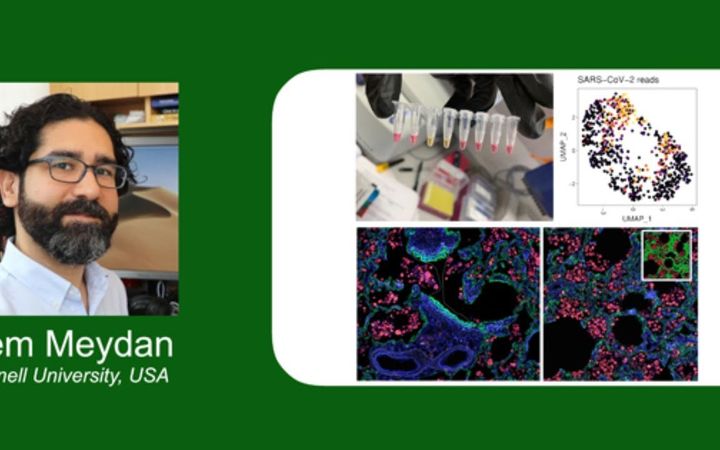
TÜBİTAK, Turkish science agency (YouTube)2021Transcriptomic, spatial and viral molecular characterization of SARS-CoV-2 infection (seminar)TalkIn Turkish

Recorded talk by Dr. Meydan in TÜBİTAK's Biological Sciences Seminar Series on transcriptomic, spatial and viral characterization of SARS-CoV-2 infection.

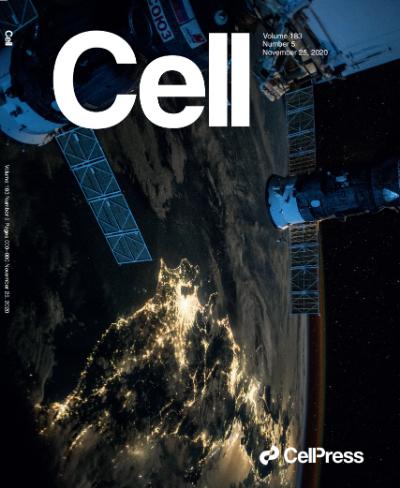
Cell cover
Biology of SpaceflightCell · 2020

Comprehensive Multi-Omics Analysis Reveals Mitochondrial Stress as a Central Hub for Spaceflight Biological Impact

A multi-omic analysis across astronauts and model organisms that put mitochondrial stress at the center of spaceflight biology, part of the Biology of Spaceflight collection.

Weill Cornell MedicineNov 25, 2020Press release

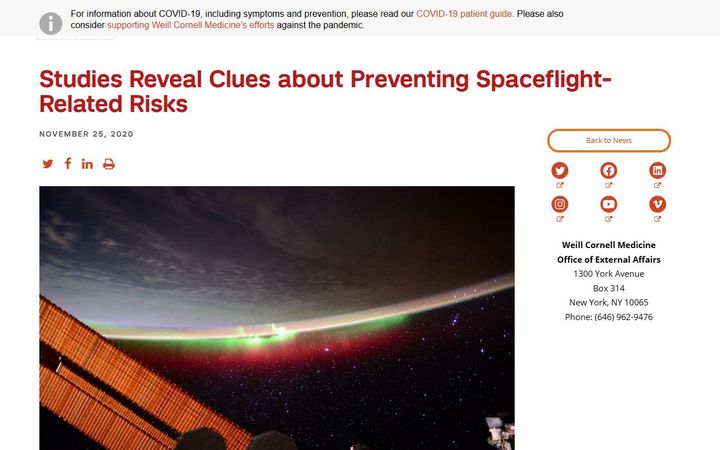
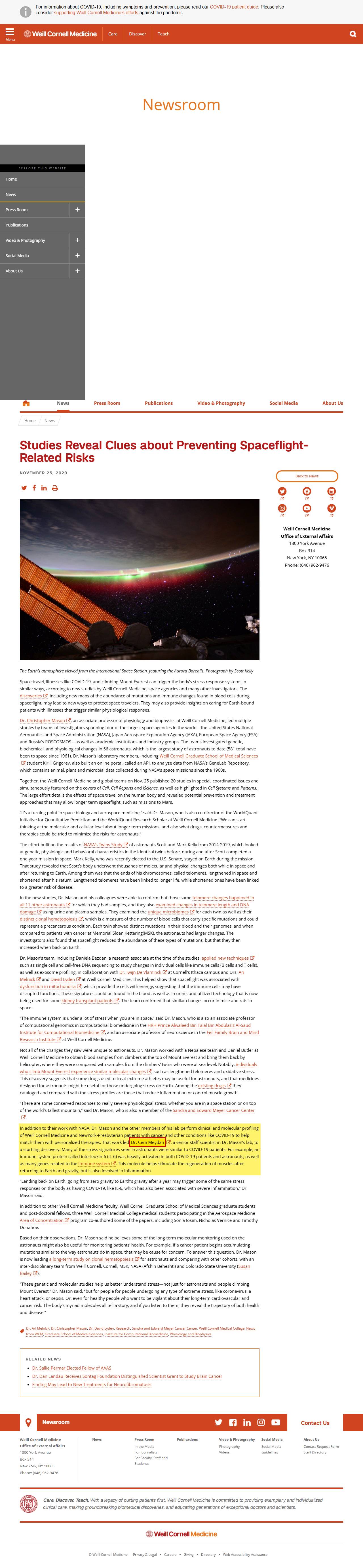
Studies Reveal Clues about Preventing Spaceflight-Related Risks

Release on a package of Cell studies finding that spaceflight, COVID-19 and Everest climbing trigger similar stress responses, with maps of blood-cell mutations and immune changes that may help protect travelers.

…nd NewYork-Presbyterian patients with cancer and other conditions like COVID-19 to help match them with personalized therapies. That work led Dr. Cem Meydan, a senior staff scientist in Dr. Mason’s lab, to a startling discovery: Many of the stress signatures seen in astronauts were similar to COVID-19 patients. For example, an immune system protein…
Passage on the Weill Cornell Medicine page

6 more

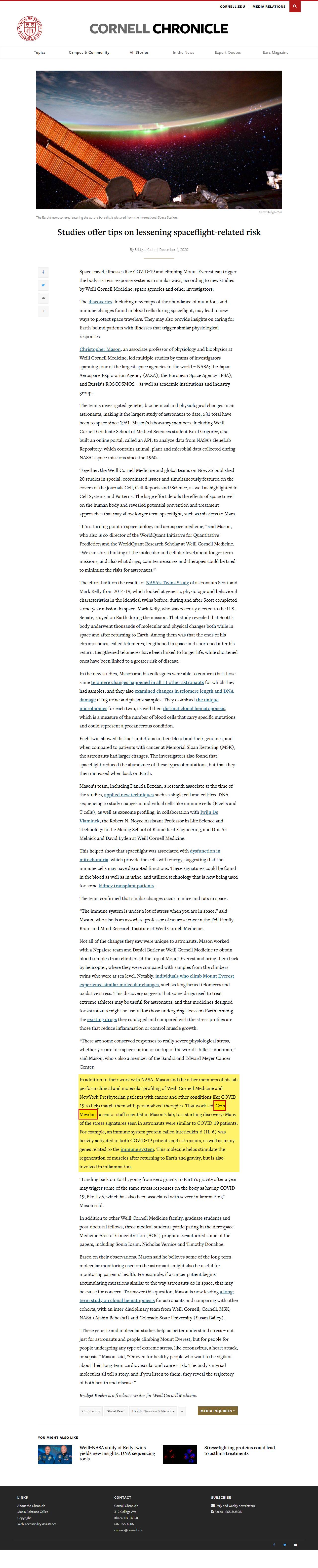
Cornell ChronicleDec 2020Studies offer tips on lessening spaceflight-related riskPress release

University story on Cell studies showing spaceflight, COVID-19 and high-altitude climbing provoke similar stress responses, with mutation and immune maps that could inform protection of space travelers.

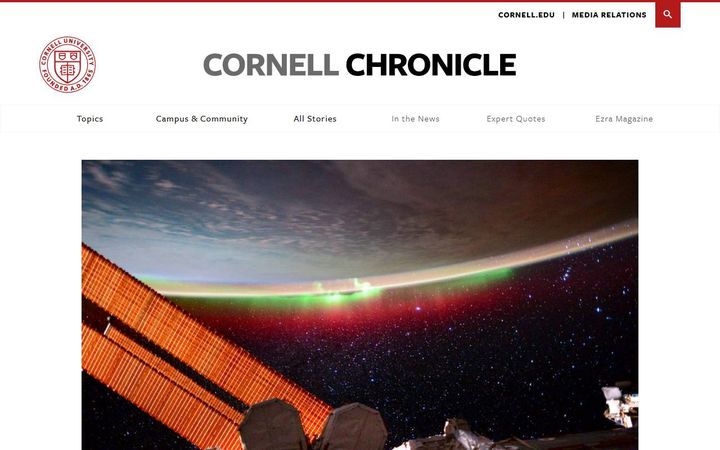
…ne and NewYork-Presbyterian patients with cancer and other conditions like COVID-19 to help match them with personalized therapies. That work led Cem Meydan, a senior staff scientist in Mason’s lab, to a startling discovery: Many of the stress signatures seen in astronauts were similar to COVID-19 patients. For example, an immune system protein cal…
Passage on the Cornell Chronicle page
Nature Reviews GeneticsDec 2020Spaceflight causes mitochondrial stress

Research highlight of the Cell paper integrating multi-omics data from NASA GeneLab and 59 astronauts, implicating mitochondrial stress as a central driver of spaceflight risk, partly confirmed using Twins Study data.

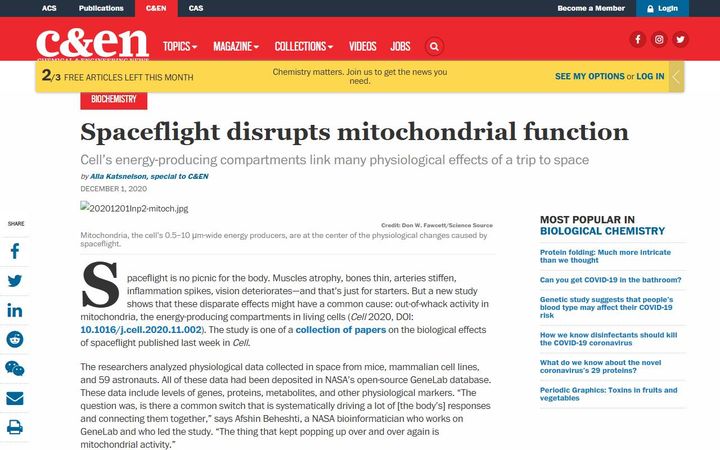
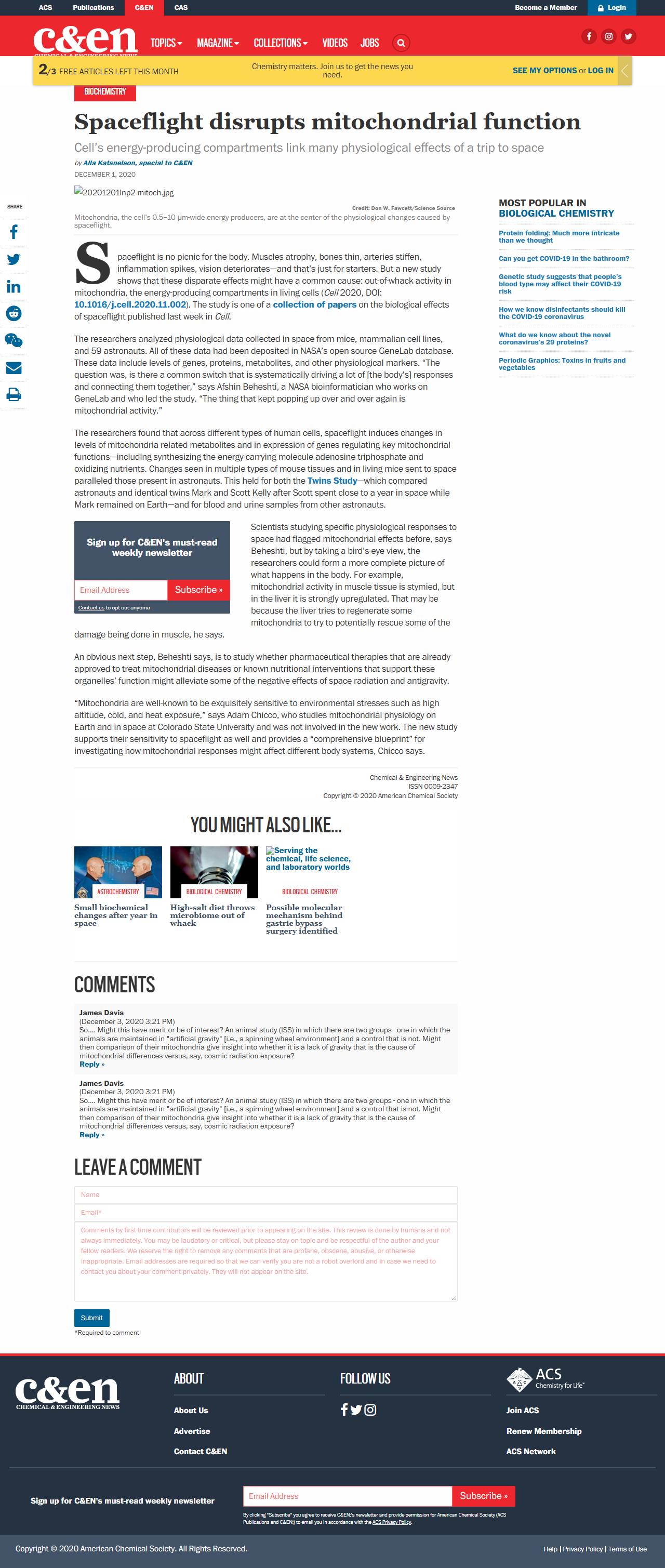
C&EN (Chemical & Engineering News)Dec 2020Spaceflight disrupts mitochondrial function

Covers a Cell study analyzing data from mice, cell lines and 59 astronauts in NASA's GeneLab, suggesting mitochondrial dysfunction as a shared driver of spaceflight's varied bodily effects.

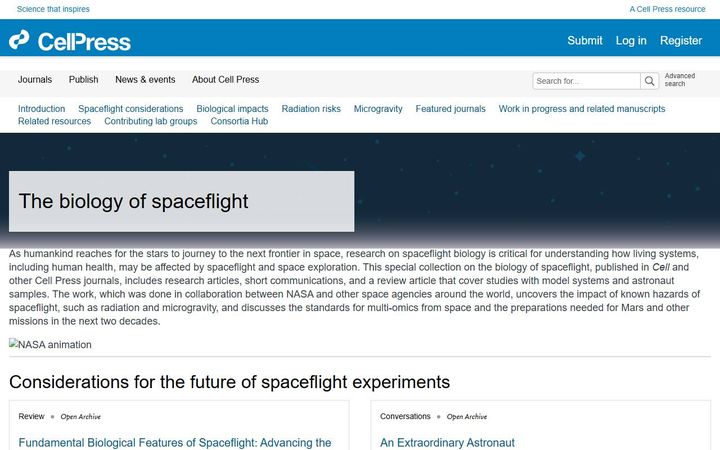
Cell PressNov 2020The Biology of Spaceflight (Cell Press consortium landing page)Interactive

Cell Press landing page for a special collection of spaceflight biology papers, from NASA and international collaborators, covering radiation, microgravity, astronaut samples and multi-omics standards, and preparation for Mars missions.

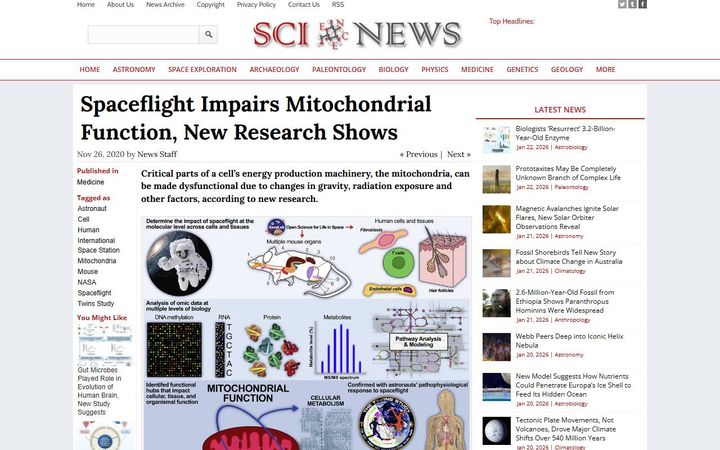
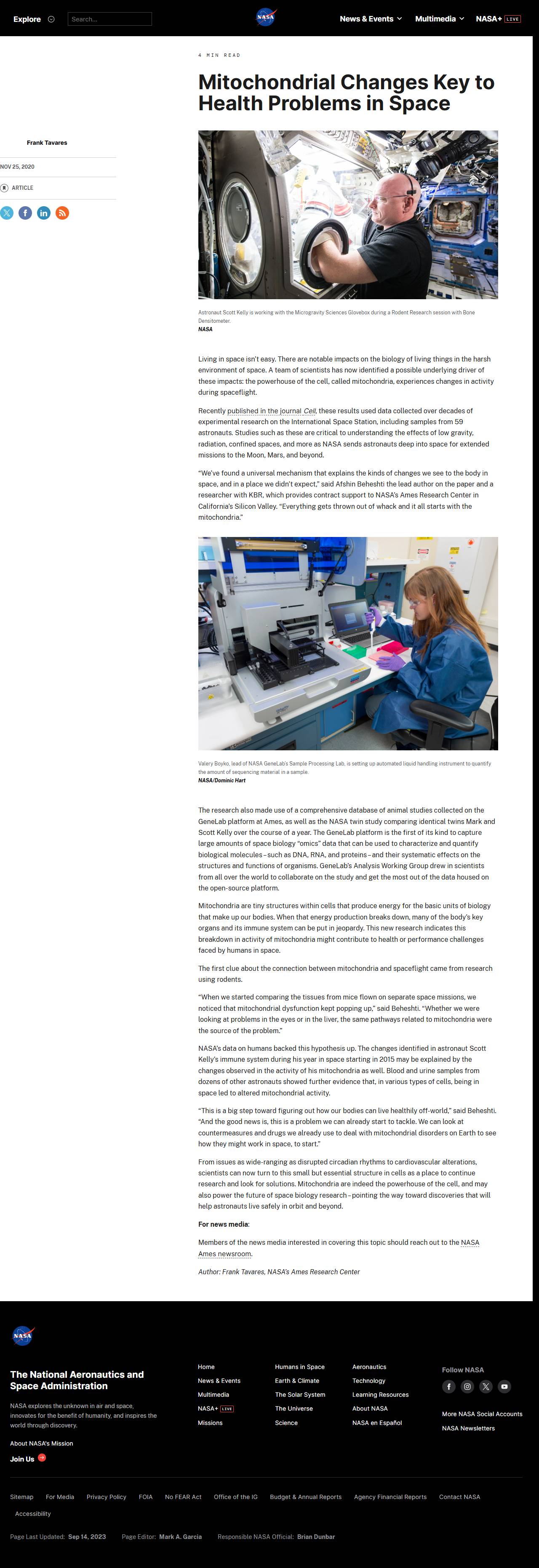
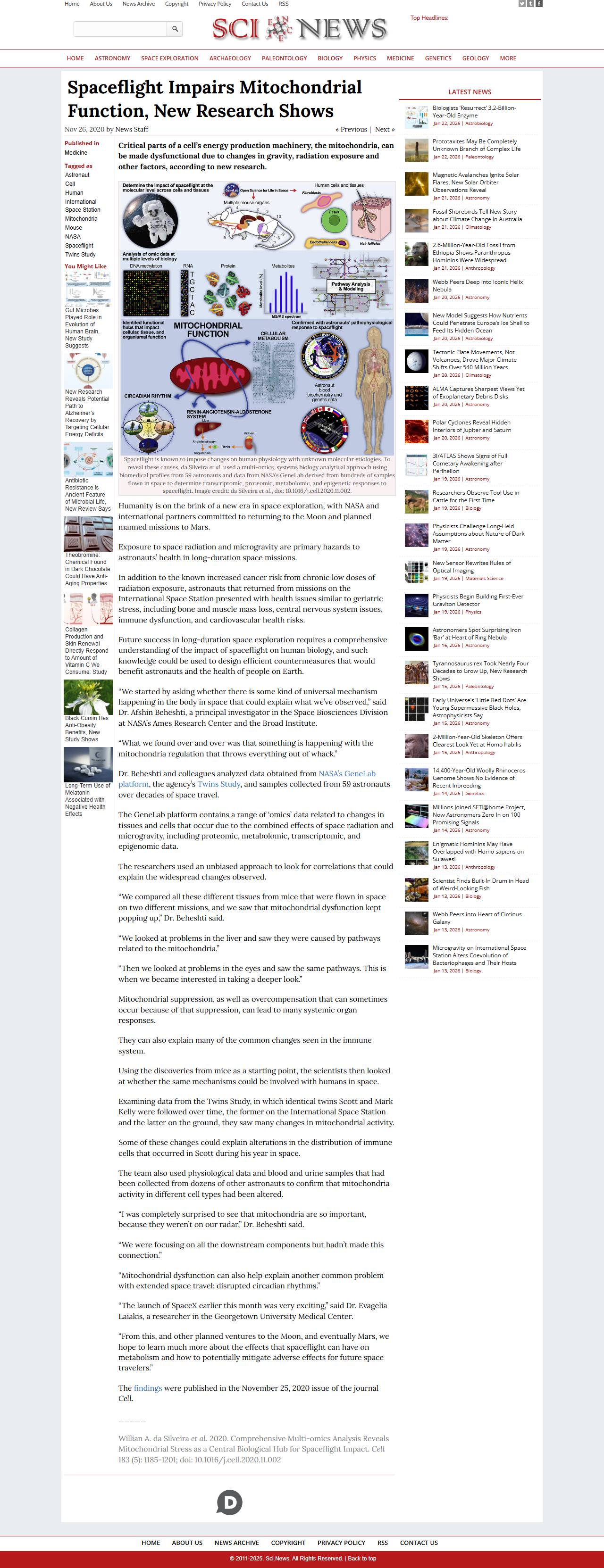
Sci.NewsNov 2020Spaceflight Impairs Mitochondrial Function, New Research Shows

Reports a Cell study using multi-omics data from 59 astronauts and GeneLab samples, finding that gravity changes and radiation can impair mitochondria, linking to geriatric-like health issues.

Queen's University BelfastNov 2020Research finds new link between cell damage in astronauts and geriatric-type health problemsPress release

University press release highlighting its researchers' role in a Cell paper tying mitochondrial damage in spaceflight to astronauts' aging-like problems, with nutrition support such as coenzyme suggested.

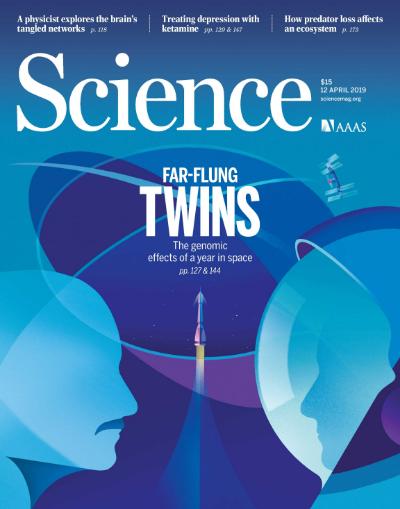
Science cover
NASA Twins StudyScience · 2019

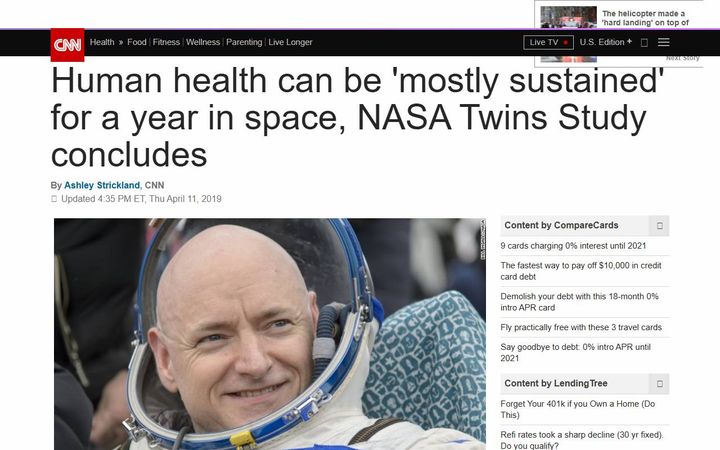
The NASA Twins Study: A multidimensional analysis of a year-long human spaceflight

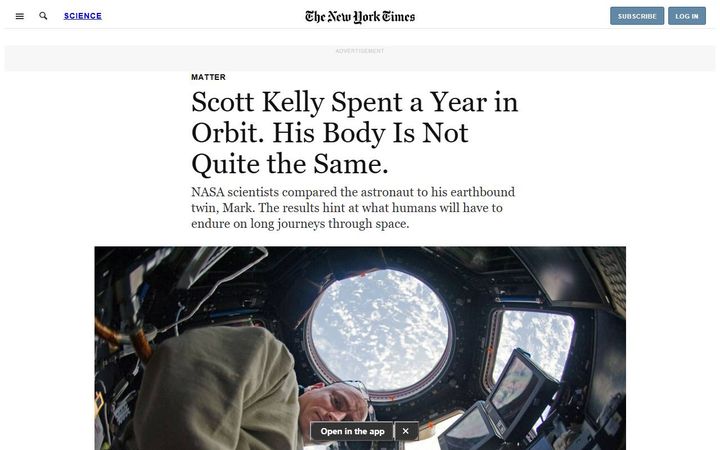
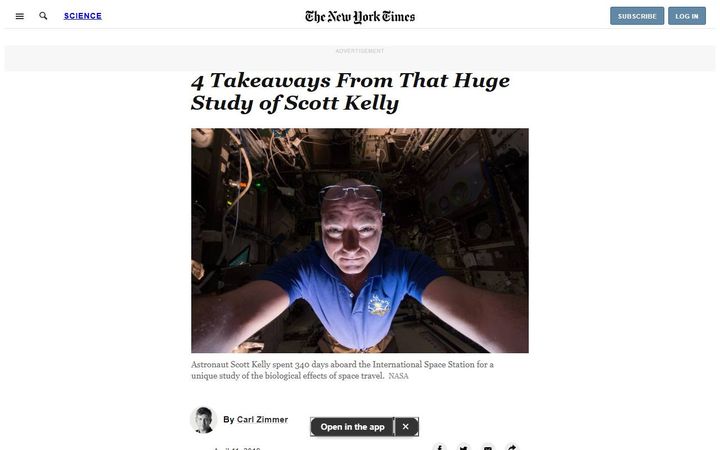
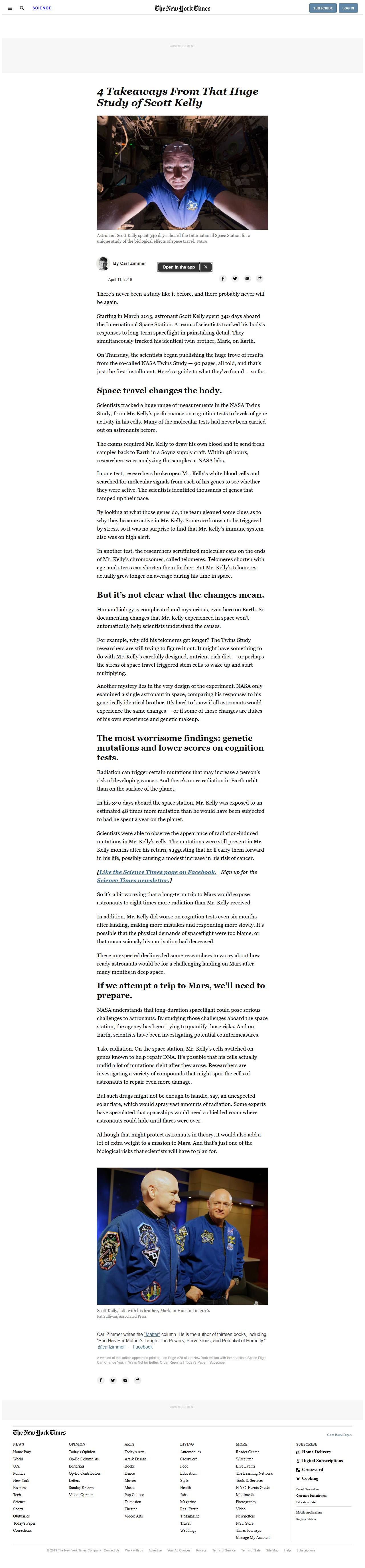
A year-long multi-omic comparison of astronaut Scott Kelly on the ISS with his identical twin on Earth, the most complete look at the human body in long-duration spaceflight. Covered by The New York Times, CNN, STAT and MIT Technology Review.

15 more

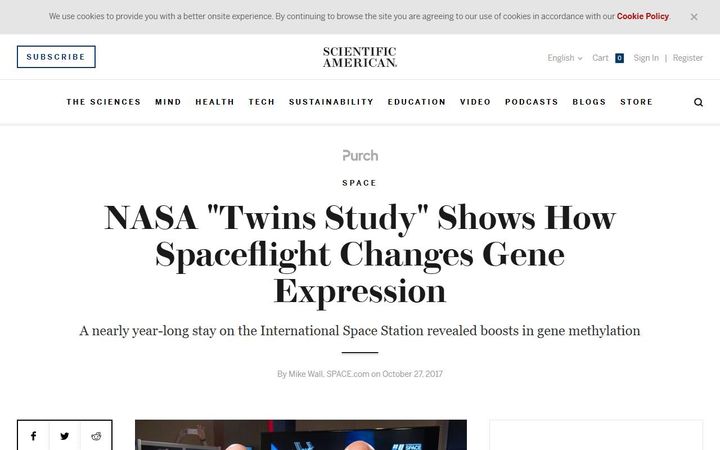
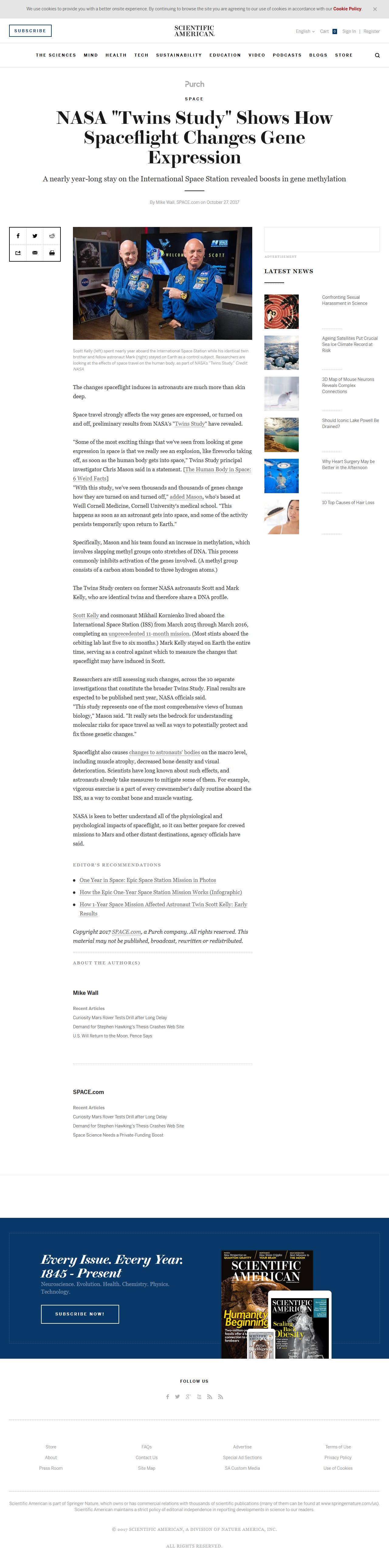
Scientific AmericanOct 27, 2017NASA "Twins Study" Shows How Spaceflight Changes Gene Expression

Early report of preliminary Twins Study results showing spaceflight strongly shifts gene expression, with thousands of genes changing quickly once in space, per the study's principal investigator.

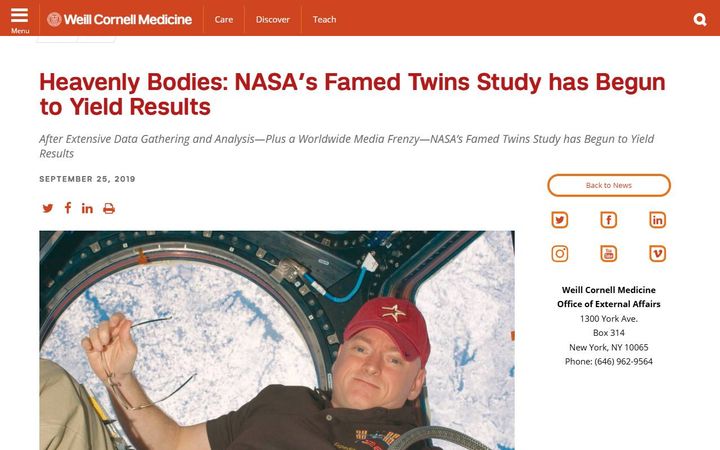
Weill Cornell MedicineSep 2019Heavenly Bodies: NASA's Famed Twins Study has Begun to Yield ResultsPress release

Weill Cornell feature on early Twins Study results, highlighting surprising telomere lengthening in space that reverted on return, the one-subject limitation, and optimism about longer missions.

…longer, though they reverted to normal after he came home. Why? Researchers don’t yet know. “We need to do a lot more science on this,” says Dr. Cem Meydan, a research associate in the Dr. Mason Lab and a co-first author on the Science paper. “We need to find out why this is happening, and whether we can prevent it or study it for other health-rel…
Passage on the Weill Cornell Medicine page
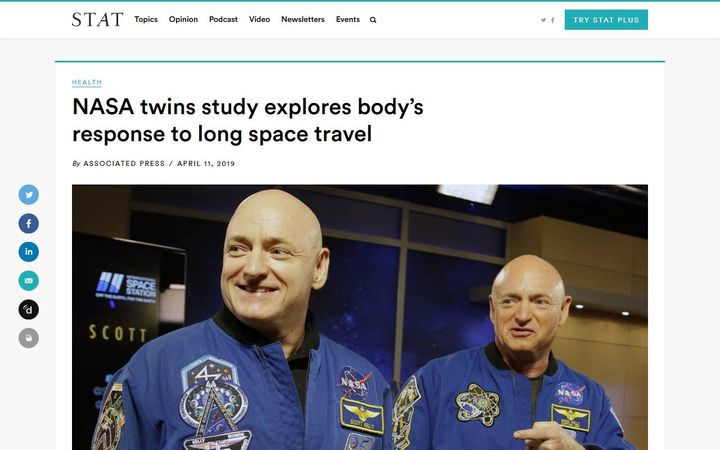
STATApr 11, 2019NASA twins study explores body's response to long space travel

Covers publication in Science of the final Twins Study results, finding unusual immune and eye effects but nothing that rules out longer missions such as Mars, with Kelly largely recovering.

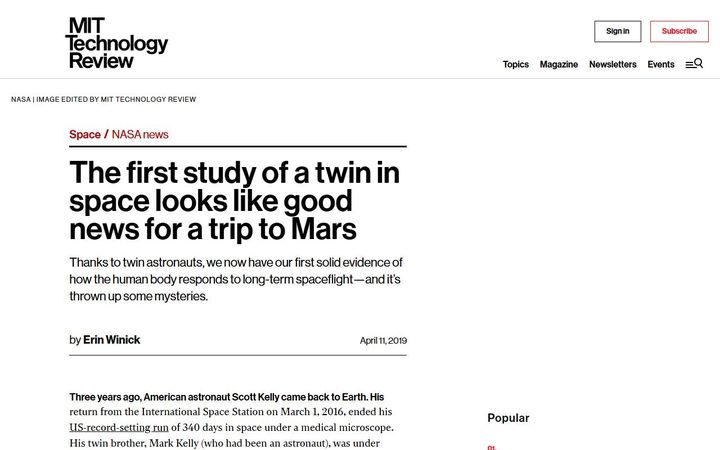
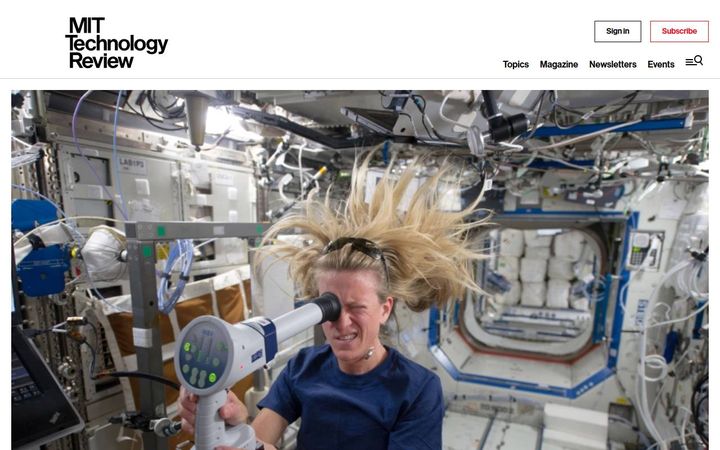
MIT Technology ReviewApr 11, 2019The first study of a twin in space looks like good news for a trip to Mars

Reports the first Twins Study results in Science: Scott Kelly's 340 days on the ISS, compared with his twin on Earth, give the first solid evidence of how the body responds to long spaceflight. Mostly good news for a trip to Mars, with some open mysteries.

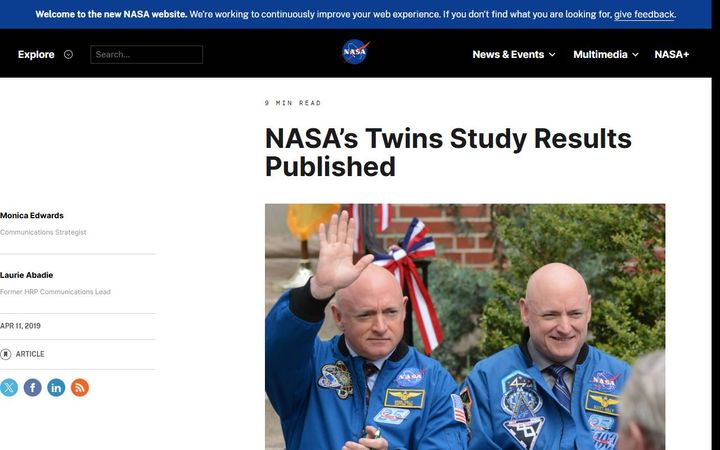
NASAApr 11, 2019NASA's Twins Study Results Published in Science JournalPress release

NASA announcement of the combined Twins Study paper in Science, presenting ten teams' findings as reassuring about the body's adaptation and a stepping-stone toward Mars-length missions.

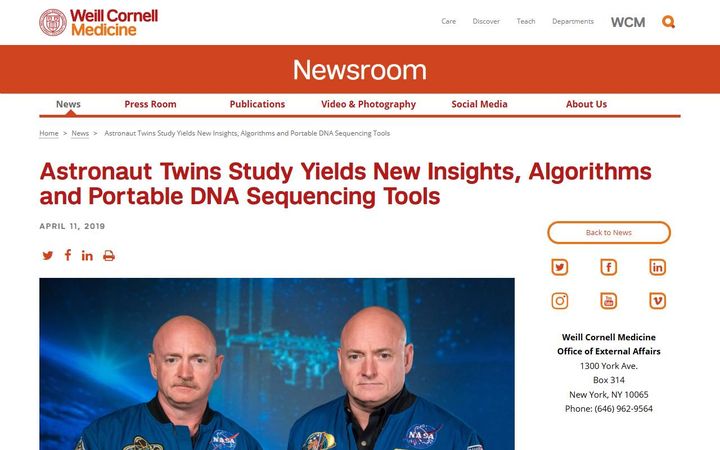
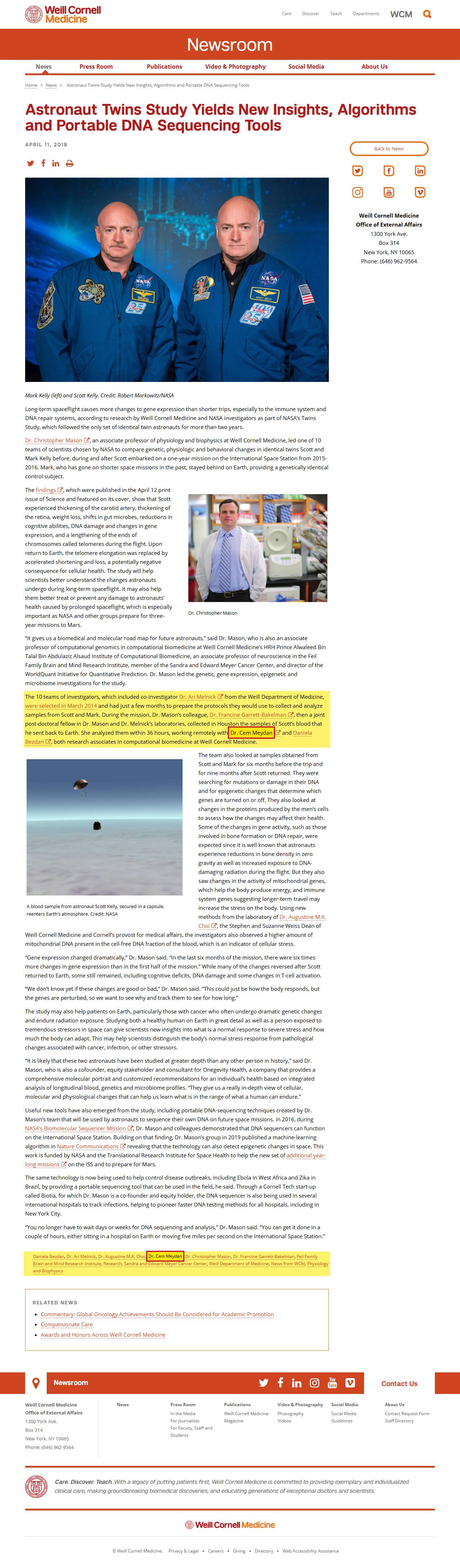
Weill Cornell MedicineApr 11, 2019Astronaut Twins Study Yields New Insights, Algorithms and Portable DNA Sequencing ToolsPress release

Weill Cornell release reporting that longer spaceflight causes more gene-expression change than shorter trips, especially in immune and DNA-repair systems, from one of ten NASA Twins Study teams.

…ories, collected in Houston the samples of Scott’s blood that he sent back to Earth. She analyzed them within 36 hours, working remotely with Dr. Cem Meydan and Daniela Bezdan, both research associates in computational biomedicine at Weill Cornell Medicine.
Passage on the Weill Cornell Medicine page
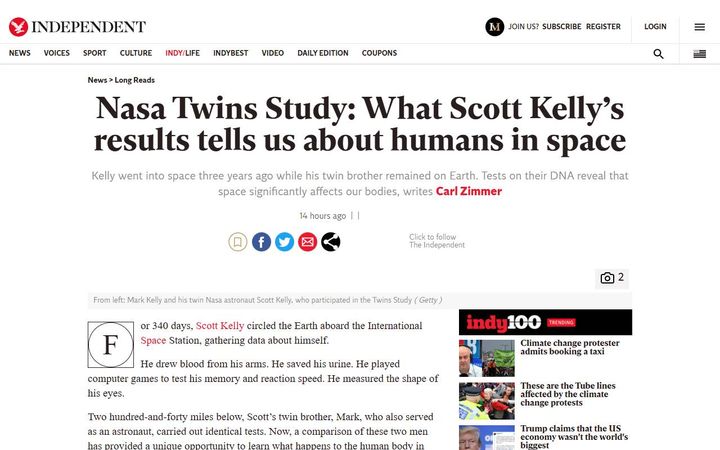
The IndependentApr 2019Nasa Twins Study: What Scott Kelly's results tells us about humans in space

Long-form reprint of Carl Zimmer's account of the Twins Study, describing Scott Kelly's molecular changes in orbit including mutated DNA, new immune signals and a changed microbiome, many of which reversed.

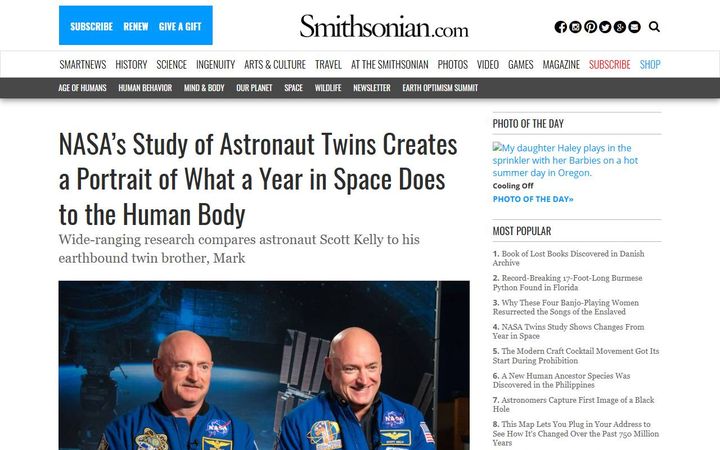
Smithsonian MagazineApr 2019NASA's Study of Astronaut Twins Creates a Portrait of What a Year in Space Does to the Human Body

Frames the Twins Study as vital for planning Mars missions, describing how Mark Kelly served as an Earth-based genetic control to isolate effects of microgravity, radiation and confinement on Scott.

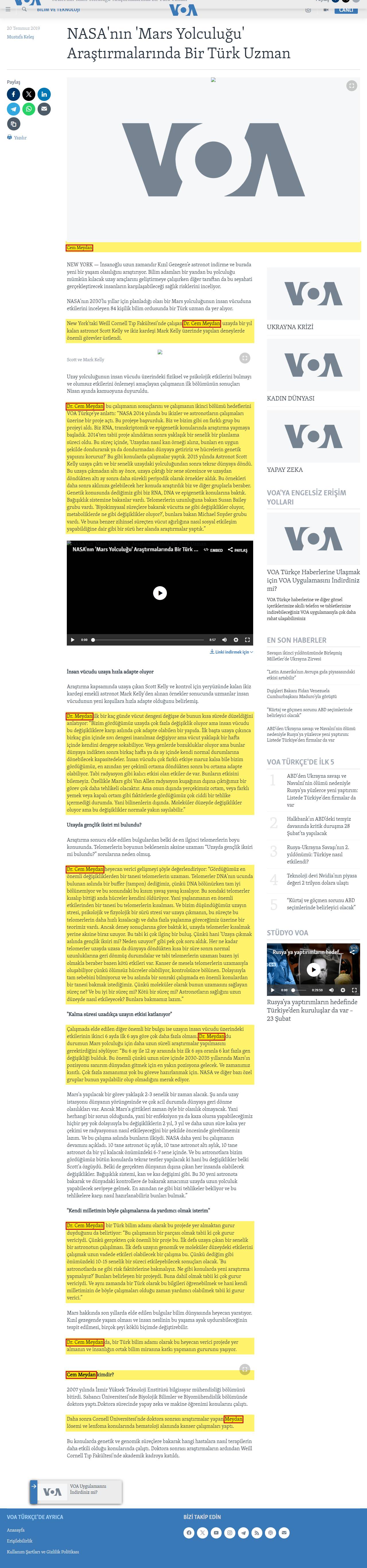
Voice of America (Turkish service)2019A Turkish expert in NASA's 'Journey to Mars' researchVideoIn Turkish

Turkish-language VOA feature on the NASA Twins Study of astronaut Scott Kelly, in which the researcher describes RNA and epigenetic work, rapid bodily adaptation to space, temporary telomere lengthening, and goals for follow-up work toward Mars missions.

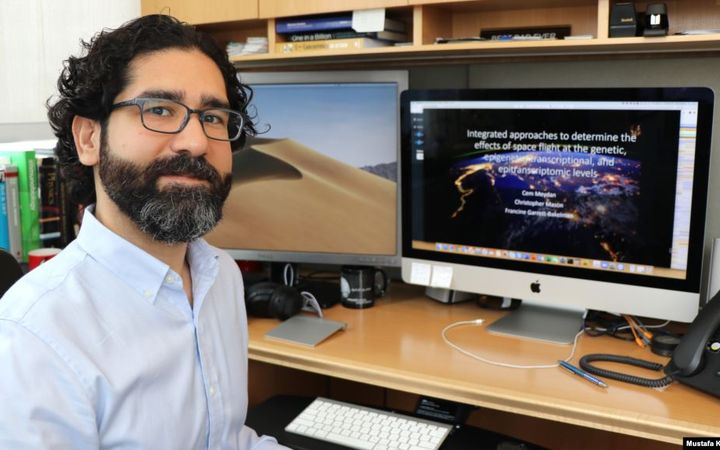
Dr. Cem Meydan of Weill Cornell Medicine in New York played key roles in the experiments on astronaut Scott Kelly, who spent a year in space, and his twin brother Mark Kelly.
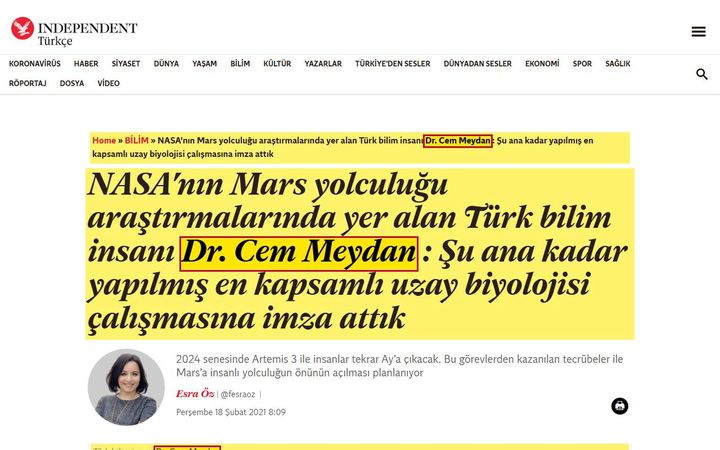
The Independent (Turkish edition)2020Dr. Cem Meydan, a Turkish scientist in NASA's Mars journey researchIn Turkish

Turkish-language article on the large 2020 package of NASA spaceflight biology papers in Cell journals (29 studies, 200+ scientists), presenting it as a step toward lunar bases and Mars crews, with interview comments on the twins findings.

Dr. Cem Meydan: “Before such long missions, finding how the space environment affects biology and developing solutions to these risks is critical for astronaut health and mission success.”
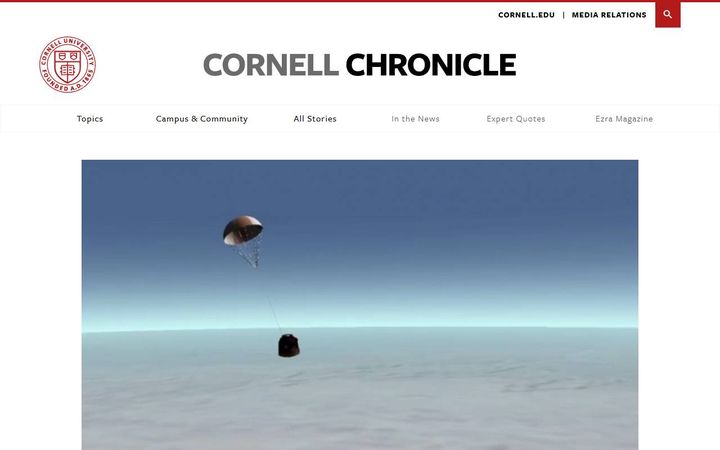
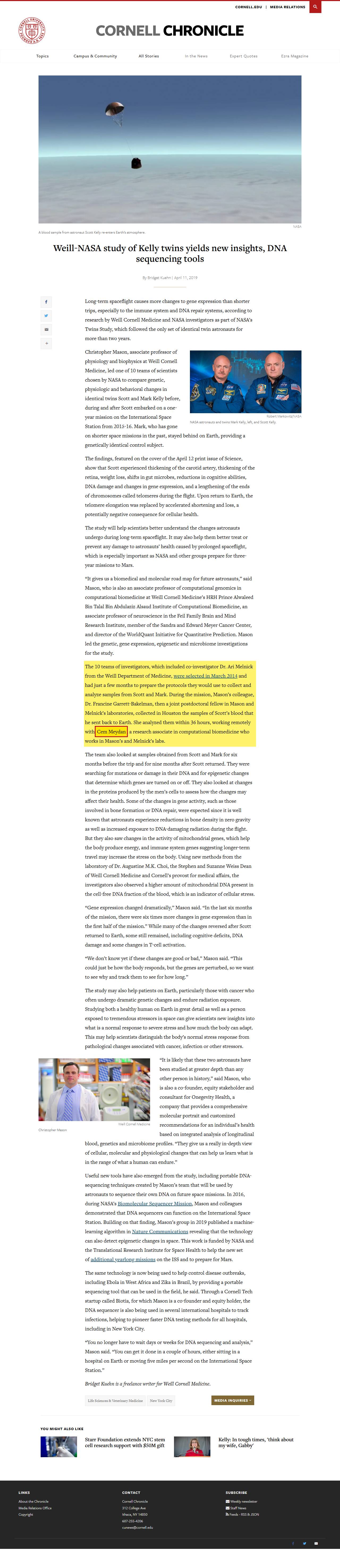
Cornell ChronicleApr 2019Weill-NASA study of Kelly twins yields new insights, DNA sequencing toolsPress release

Cornell Chronicle version of the release: Science cover findings include carotid and retinal thickening, weight loss, gut microbe shifts and DNA damage, with gene-expression change greater on longer trips.

…oratories, collected in Houston the samples of Scott’s blood that he sent back to Earth. She analyzed them within 36 hours, working remotely with Cem Meydan, a research associate in computational biomedicine who works in Mason’s and Melnick’s labs.
Passage on the Cornell Chronicle page
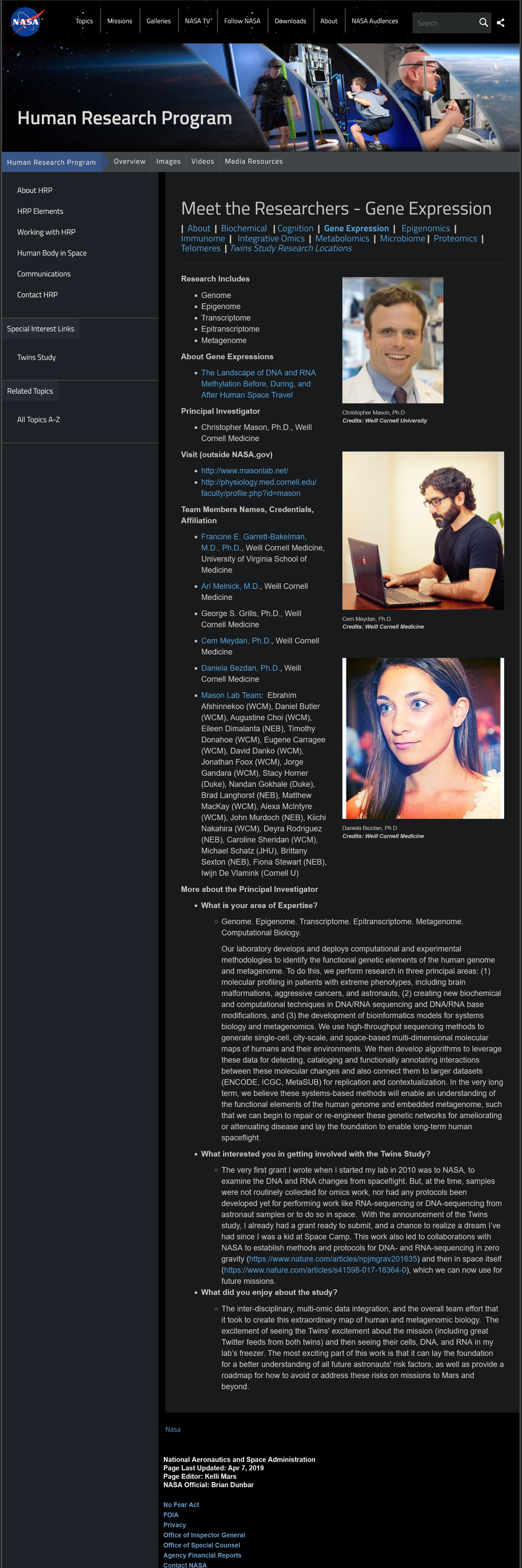
NASA2017Meet the Researchers - Gene ExpressionPress release

NASA Human Research Program profile of the Twins Study gene-expression team, which studied DNA and RNA methylation before, during and after spaceflight, led by Christopher Mason. The page has since been removed from nasa.gov; a saved copy is kept here.

Team members: Francine E. Garrett-Bakelman, M.D., Ph.D.; Ari Melnick, M.D.; George S. Grills, Ph.D.; Cem Meydan, Ph.D., Weill Cornell Medicine; Daniela Bezdan, Ph.D.
DiscoverApr 2019NASA's Twins Study: How Spaceflight (Temporarily) Changes the Body

Explains how the twins' shared genes let researchers link differences to Scott Kelly's year in orbit, noting his temporary height gain and other changes that largely reverted afterward.

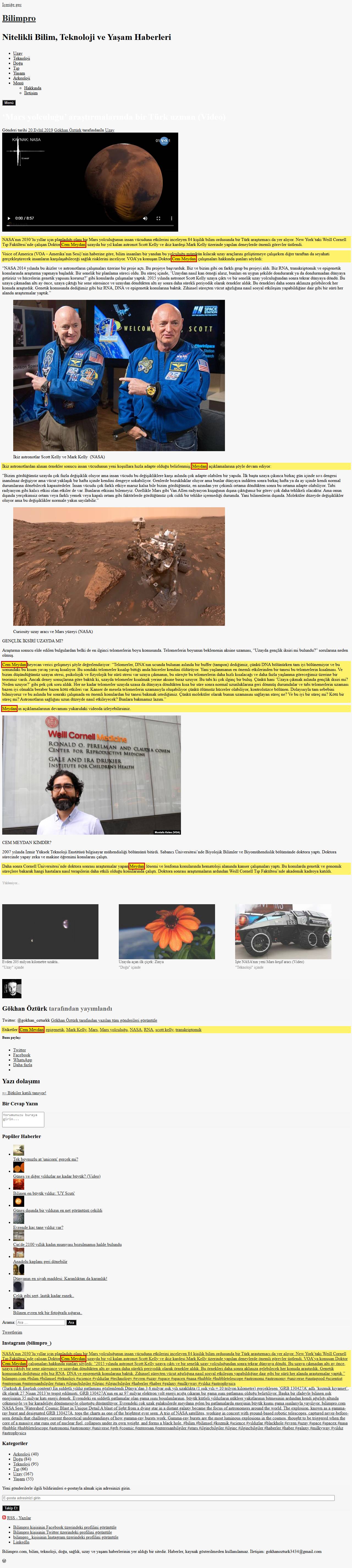
BilimProSep 20, 2019A Turkish expert in 'Journey to Mars' research (video)VideoIn Turkish

Turkish science site's write-up of the VOA video report on the NASA Twins Study, noting an 84-person team and that astronaut samples showed the body adapting quickly to spaceflight conditions.

A Turkish researcher is part of the 84-member scientific team studying the effects of spaceflight. Dr. Cem Meydan of Weill Cornell Medicine played key roles in the experiments on astronaut Scott Kelly and his twin brother Mark Kelly.
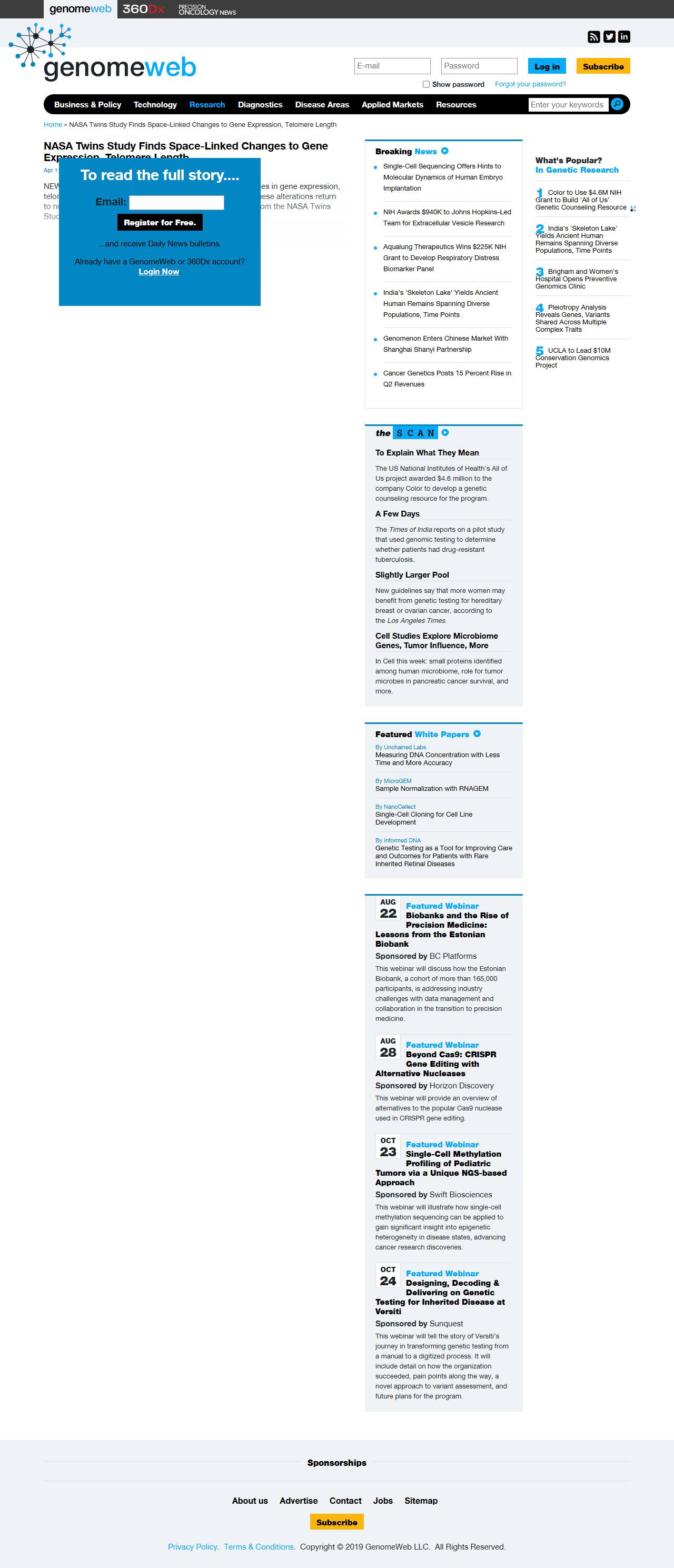
GenomeWebApr 2019NASA Twins Study Finds Space-Linked Changes to Gene Expression, Telomere Length

Trade report that spaceflight altered gene expression, telomere length and other measures in the NASA Twins Study, with most changes returning to normal after the astronaut came home.

NYC subway microbiomeCell Systems · 2015

Geospatial Resolution of Human and Bacterial Diversity with City-Scale Metagenomics

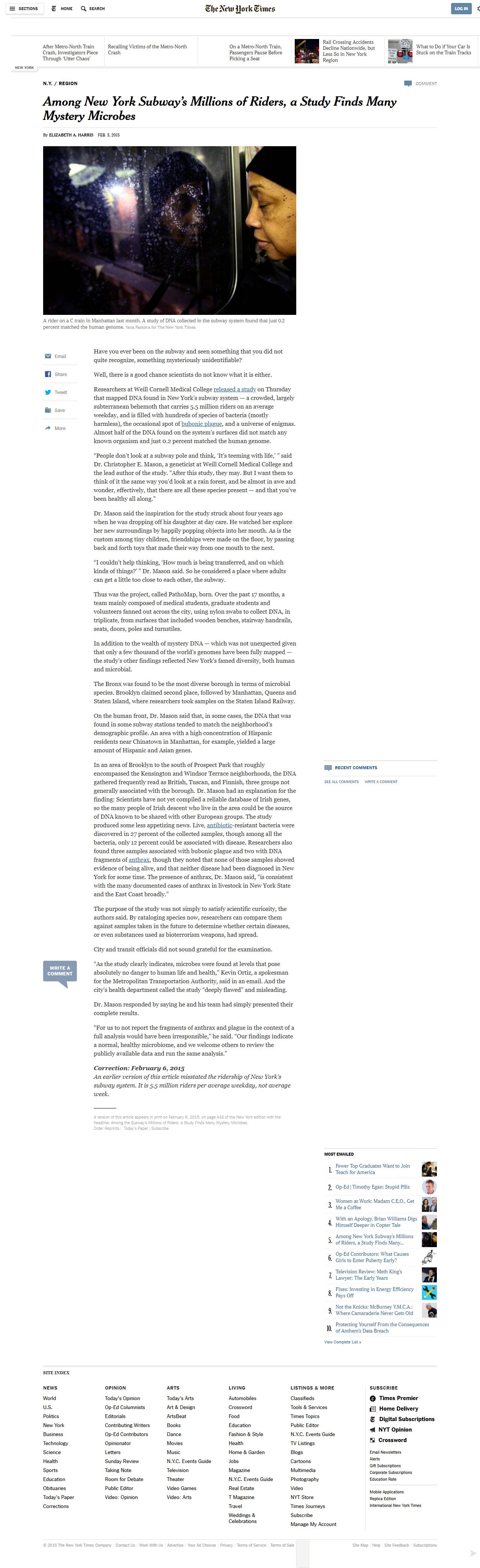
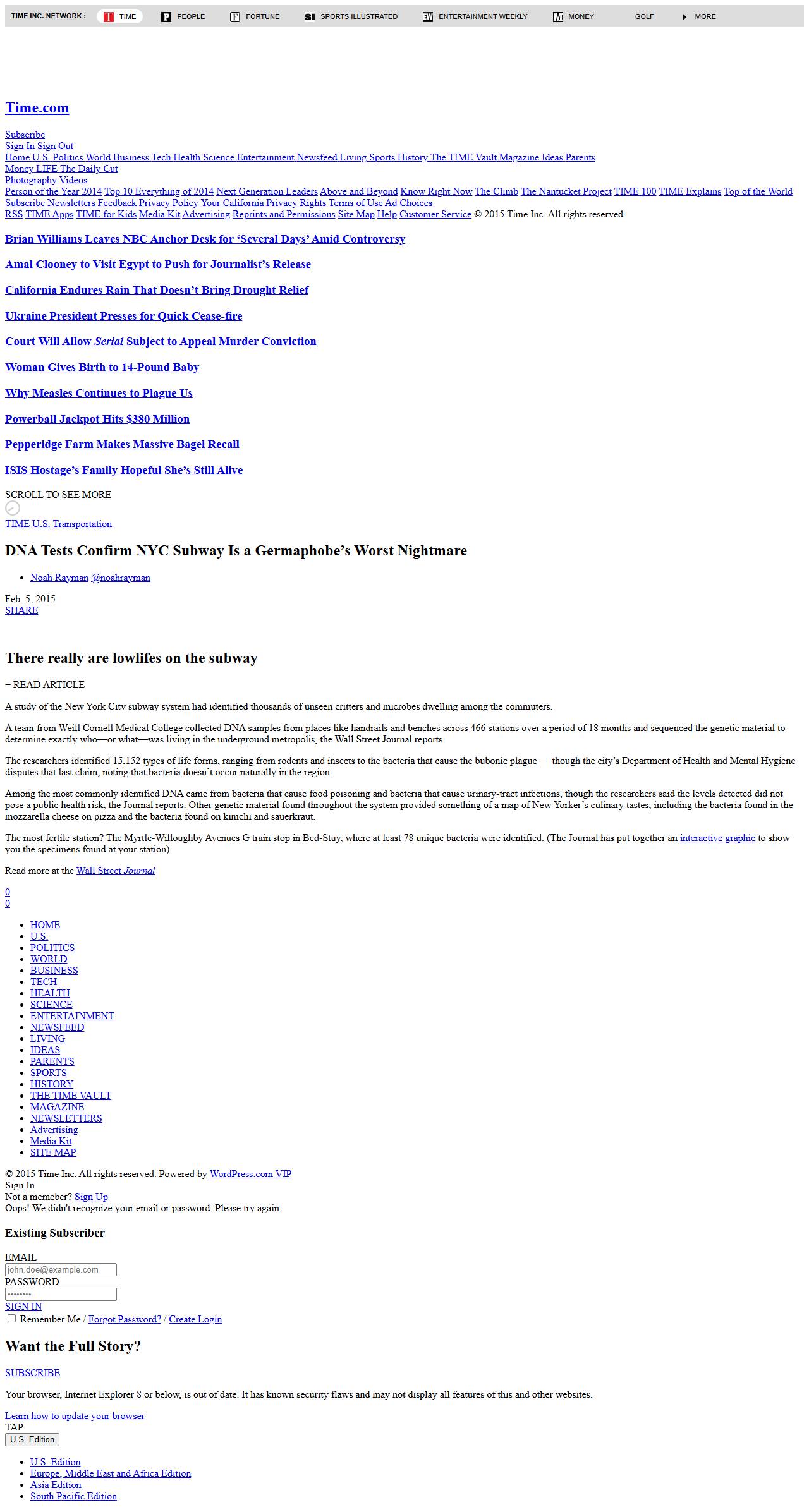
The first city-scale DNA map of a subway system, sampling all 466 open New York stations. It made the front page of The Wall Street Journal, was covered by The New York Times, WIRED, TIME and PBS NewsHour, and led to the global MetaSUB consortium.

13 more

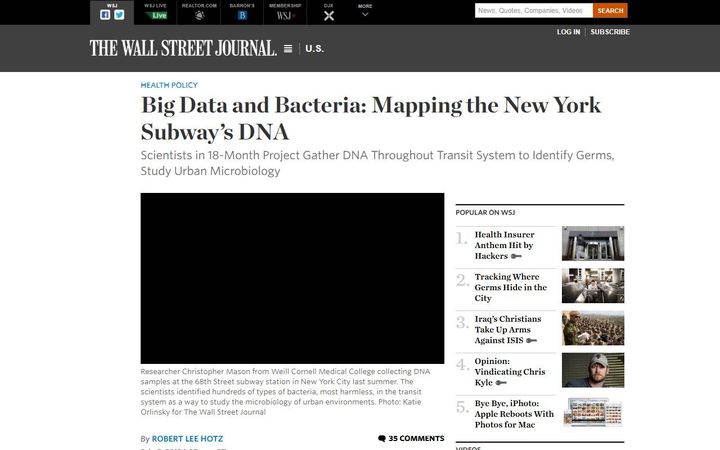
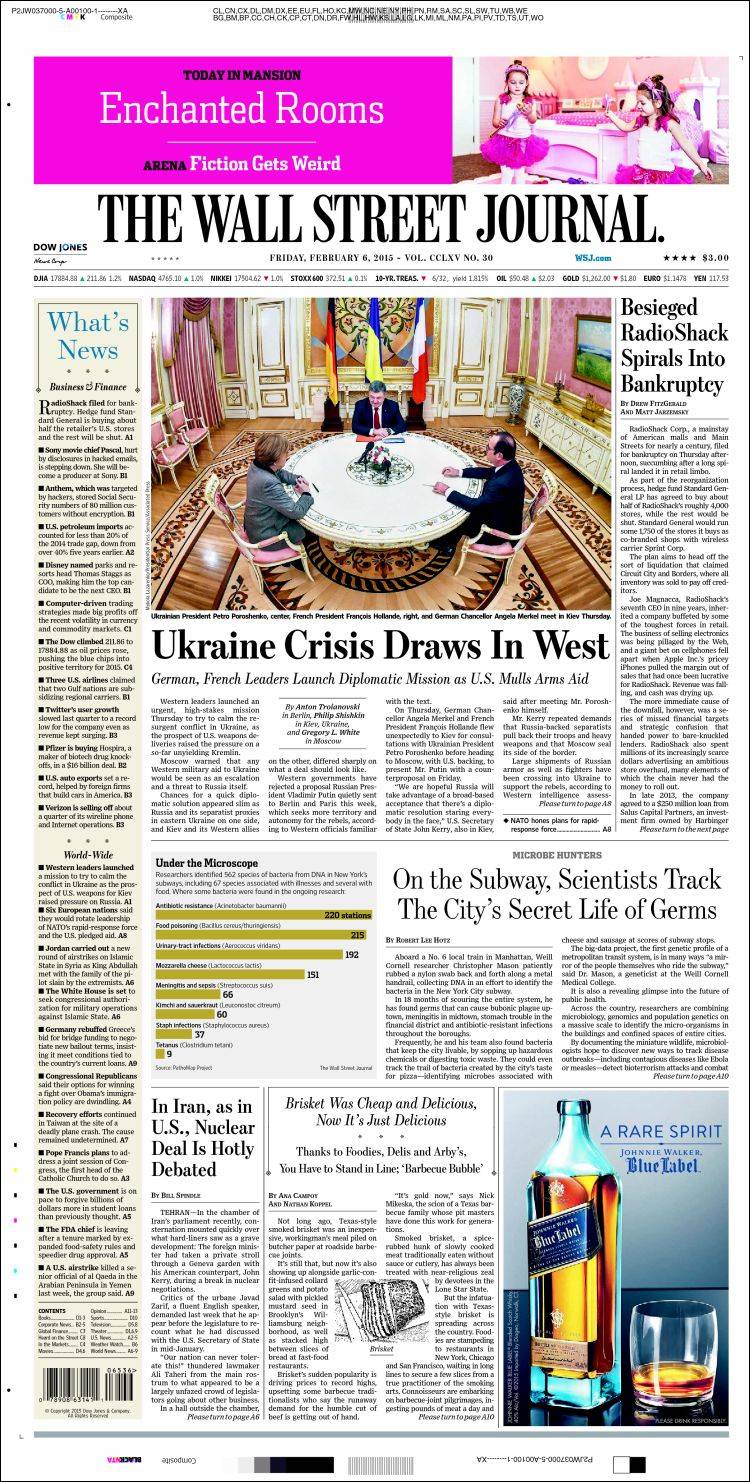
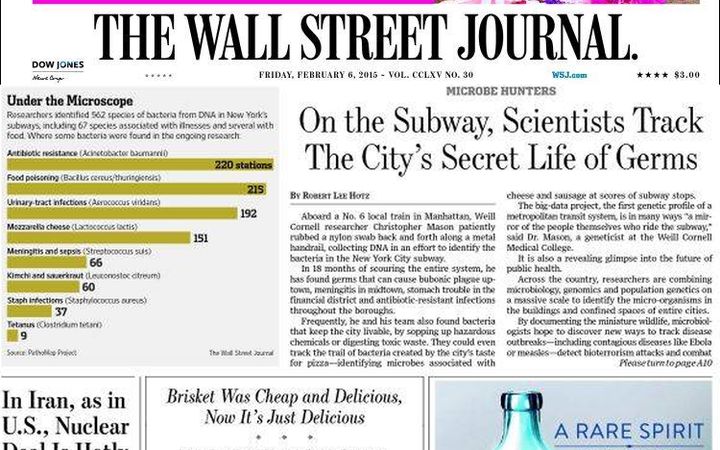
The Wall Street JournalFeb 5, 2015Big Data and Bacteria: Mapping the New York Subway's DNA

Describes the team's 18-month swabbing of the entire subway as the first genetic profile of a city transit system, finding mostly harmless microbes plus traces of disease-linked bacteria and pizza-related DNA, and framing it as a preview of big-data public health.

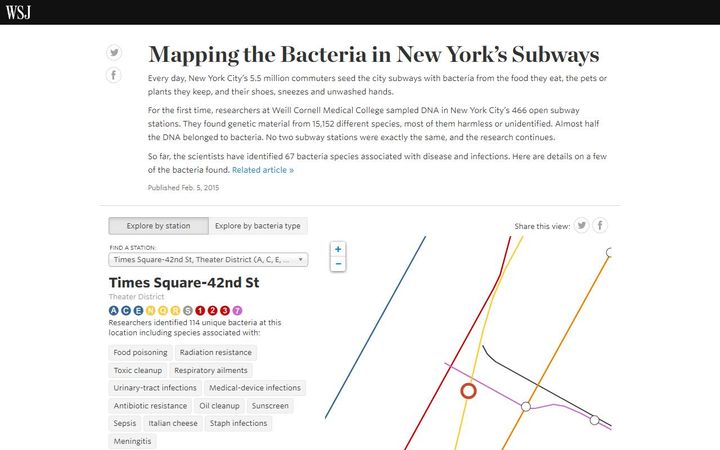
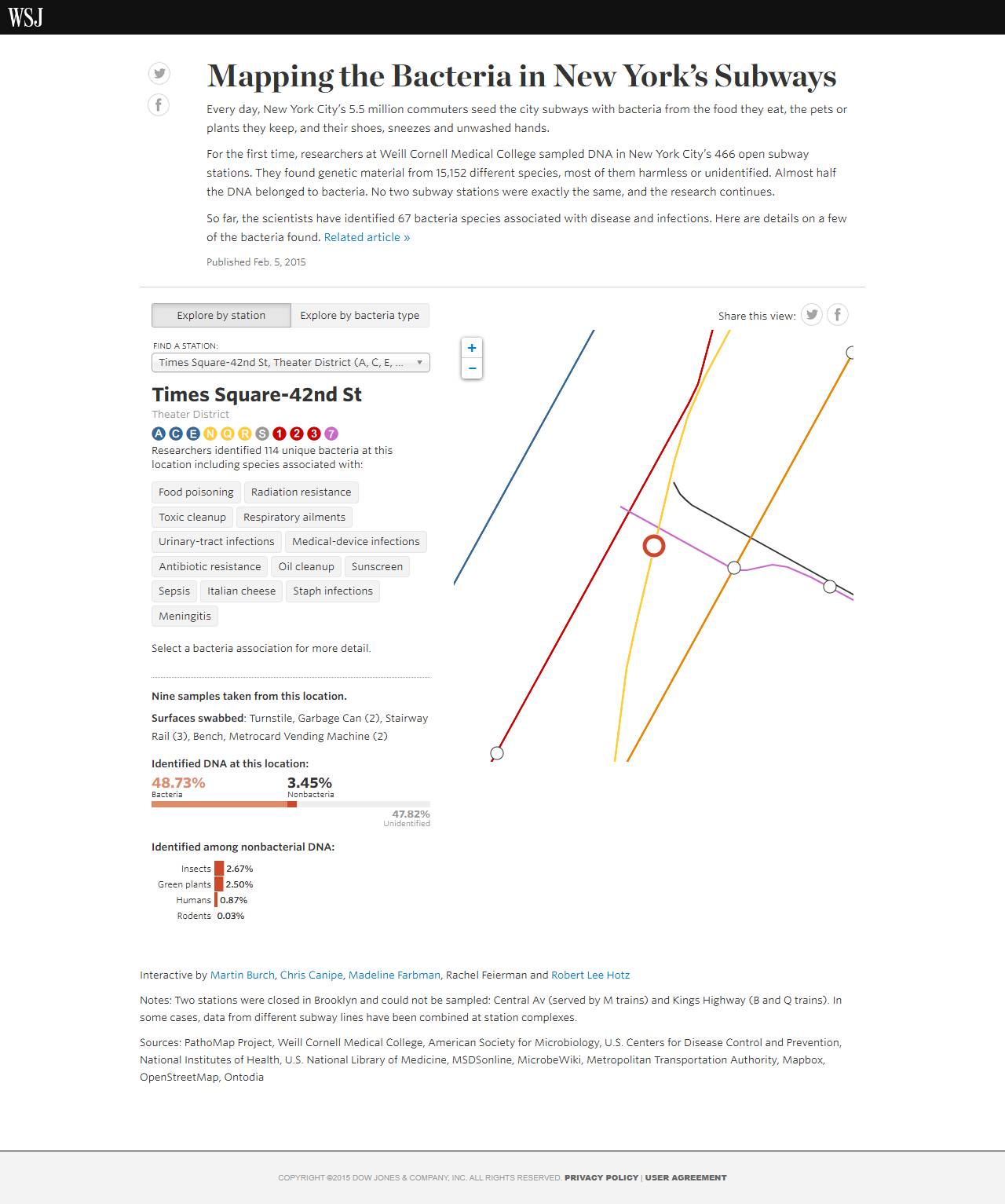
The Wall Street JournalFeb 5, 2015Mapping the Bacteria in New York's Subways (interactive)Interactive

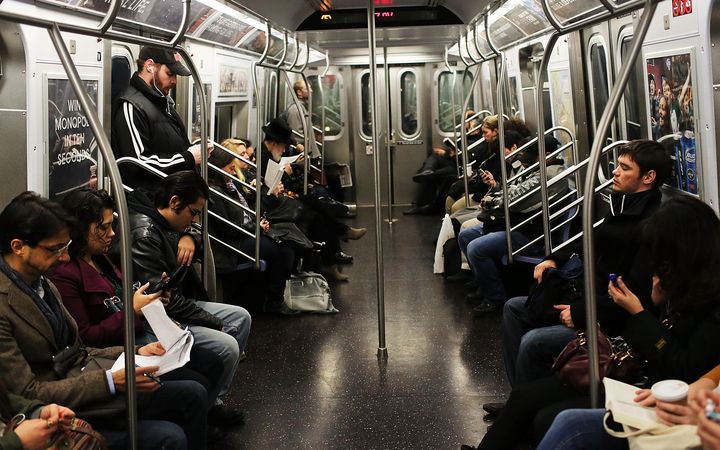
Interactive graphic showing DNA from 15,152 species across 466 stations, nearly half bacterial and 67 disease-associated species, with station-level detail; no two stations were alike.

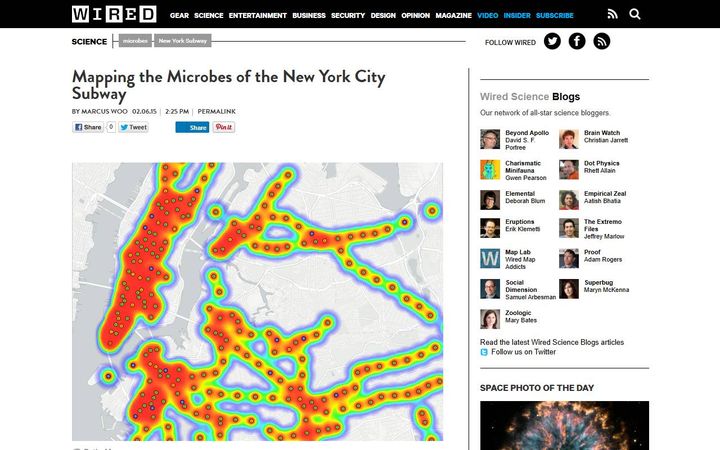
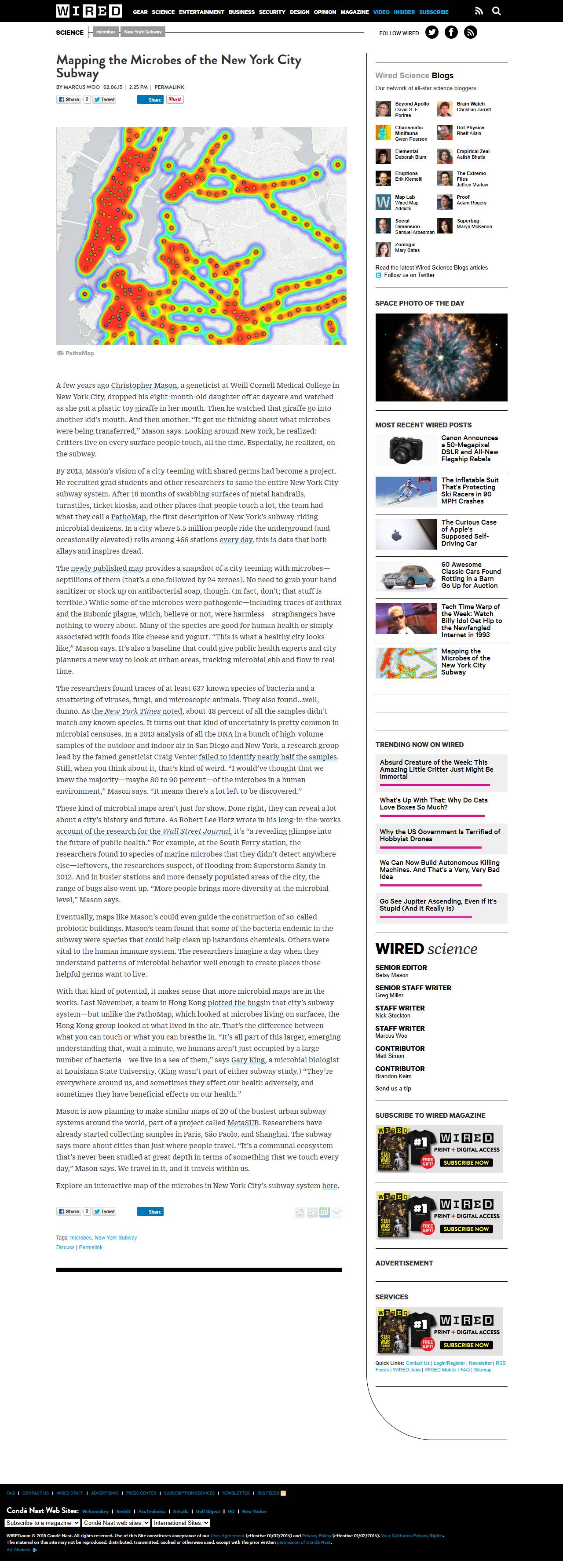
WIREDFeb 5, 2015Mapping the Microbes of the New York City Subway

Recounts how a toddler's daycare habits inspired the 18-month PathoMap project across 466 stations, which yielded the first description of the subway's microbial residents and a reassuring yet unsettling picture of shared germs.

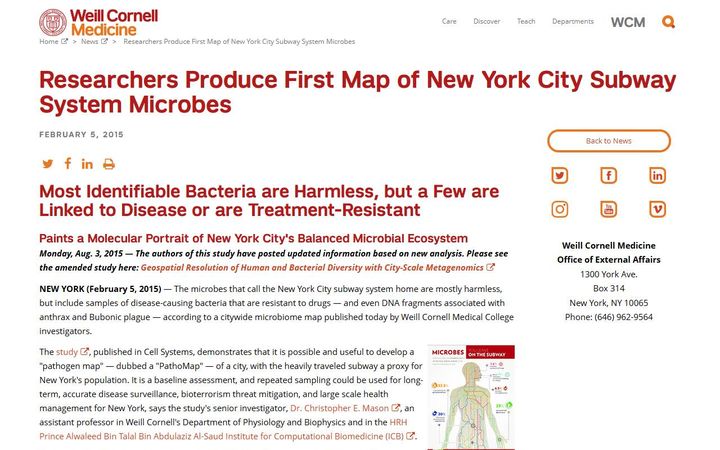
Weill Cornell MedicineFeb 5, 2015Researchers Produce First Map of New York City Subway System MicrobesPress release

Weill Cornell release announcing the Cell Systems subway map as a baseline for long-term disease surveillance; microbes were mostly harmless but included drug-resistant bacteria and anthrax and plague DNA fragments.

…t maps that detail what organisms are present in each area of the city, creating a molecular portrait of the metropolis," says co-lead author Dr. Cem Meydan, a postdoctoral associate at Weill Cornell Medical College.
Passage on the Weill Cornell Medicine page
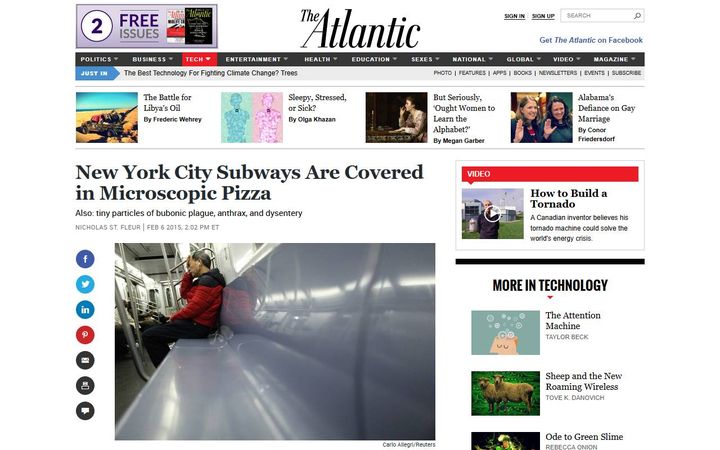
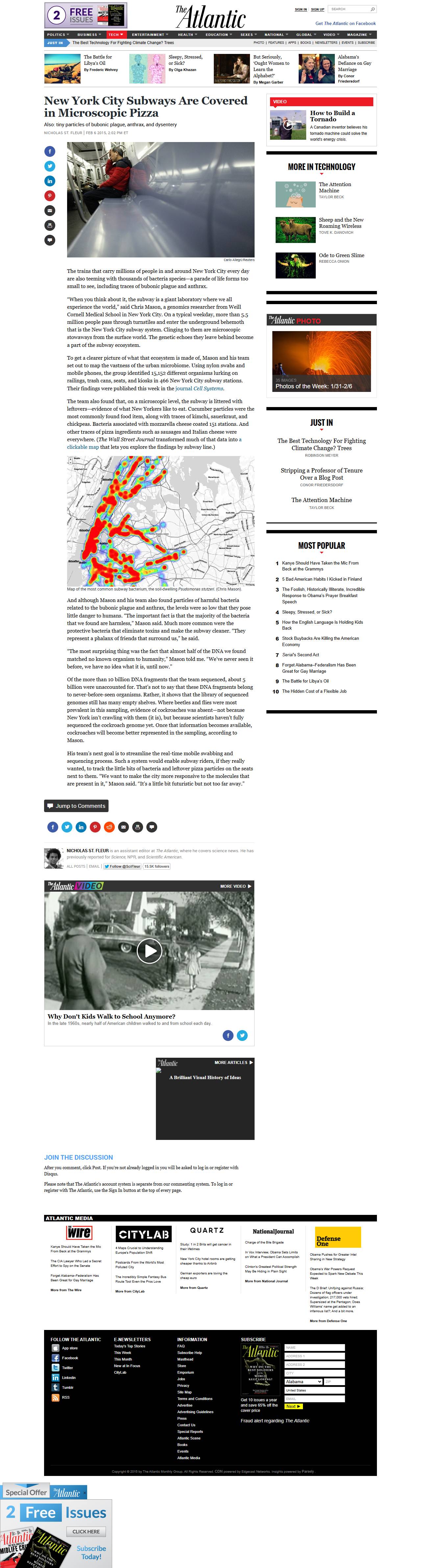
The AtlanticFeb 2015New York City Subways Are Covered in Microscopic Pizza

Explains that the Cell Systems study identified 15,152 organisms across 466 stations, including traces of plague and anthrax, and that the subway carries a record of what commuters eat, such as pizza.

CBS NewsFeb 2015New York City subway pathogens include anthrax, Bubonic plague

Reports the PathoMap of 637 known microbes, mostly harmless skin-type bacteria, with about 12 percent disease-associated and nearly half of samples showing unseen DNA; the college called results reassuring.

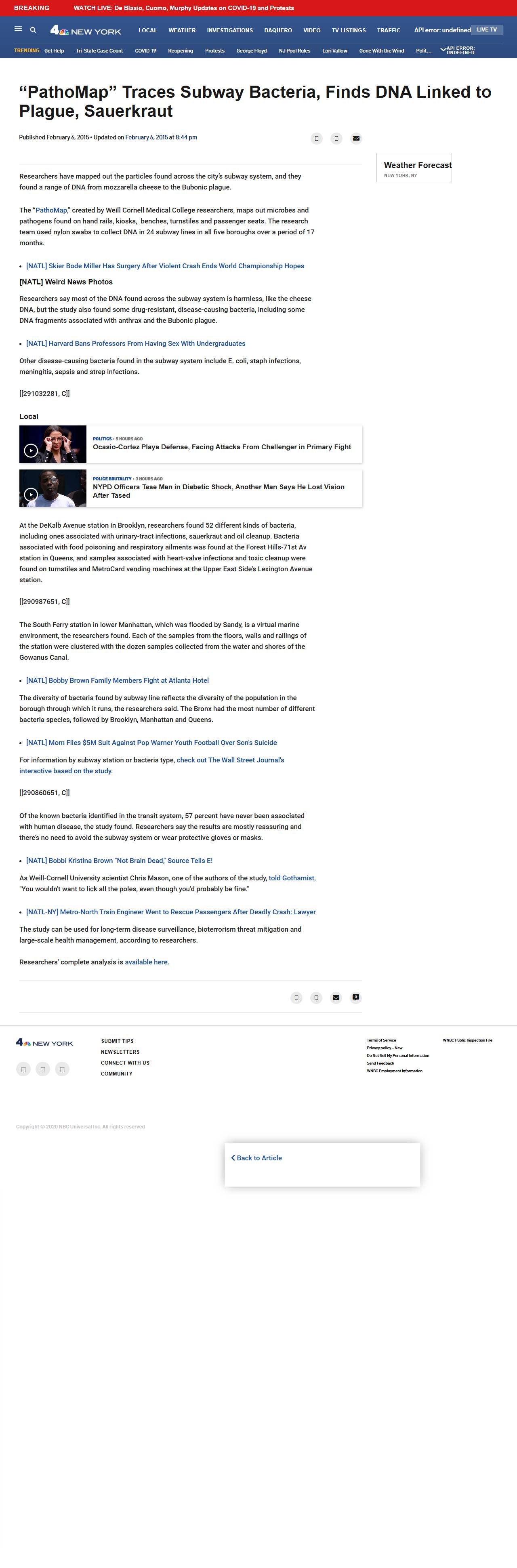
NBC New YorkFeb 2015"PathoMap" Traces Subway Bacteria, Finds DNA Linked to Plague, Sauerkraut

Local broadcast summary of the subway map across 24 lines in all five boroughs, noting mostly harmless DNA (cheese, sauerkraut) alongside drug-resistant bacteria and fragments tied to anthrax and plague.

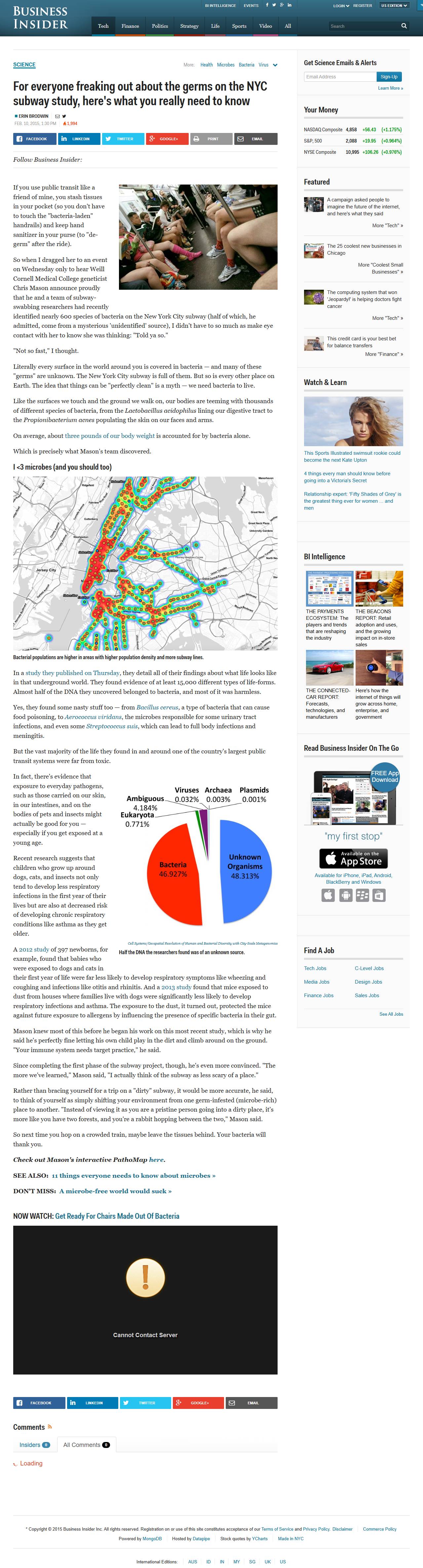
Business InsiderFeb 2015Pathomap Is Bacterial Map of NYC Subway

Explainer arguing readers should not panic over the subway findings, since bacteria are everywhere and needed for life; reports nearly 600 species identified, half from unidentified sources.

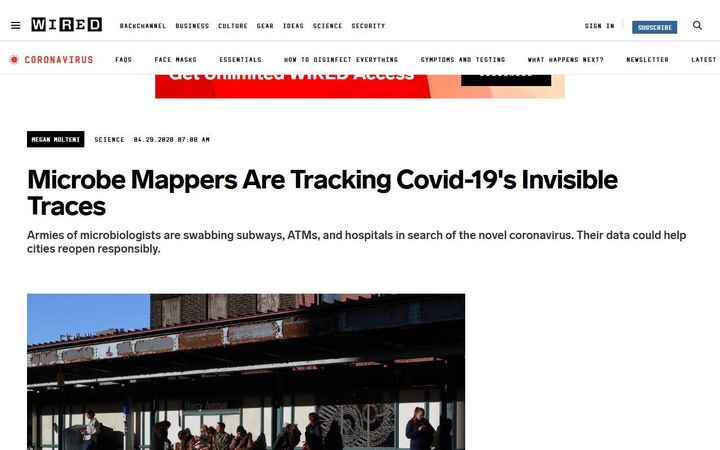
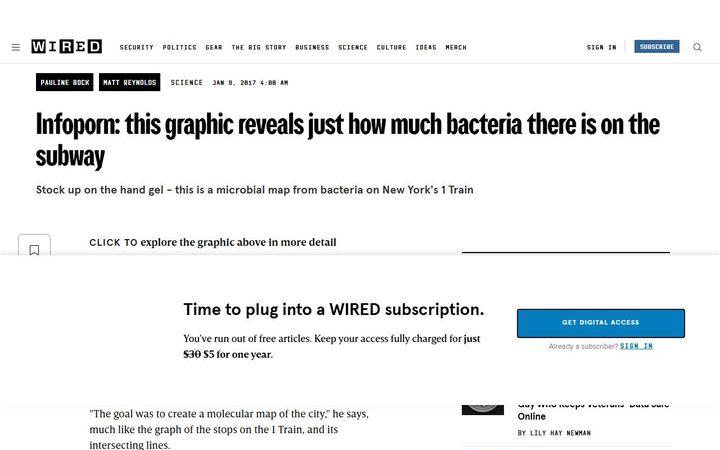
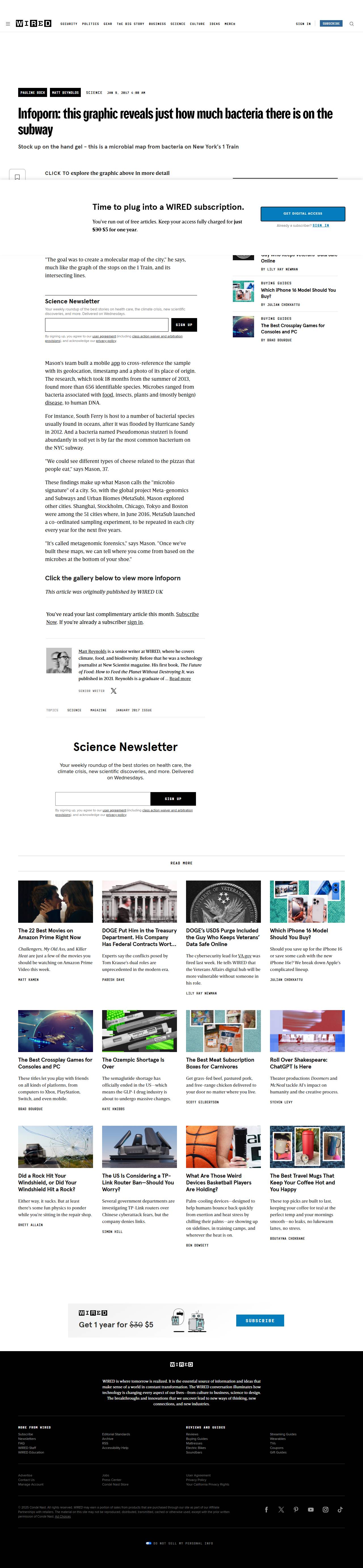
WIRED2015Infoporn: All the bacteria found on the New York Subway

Graphic-focused piece summarizing the sampling of all subway stations (over 1,500 samples) and the resulting molecular map, noting traces such as ocean-type bacteria at the Sandy-flooded South Ferry station and food-derived DNA.

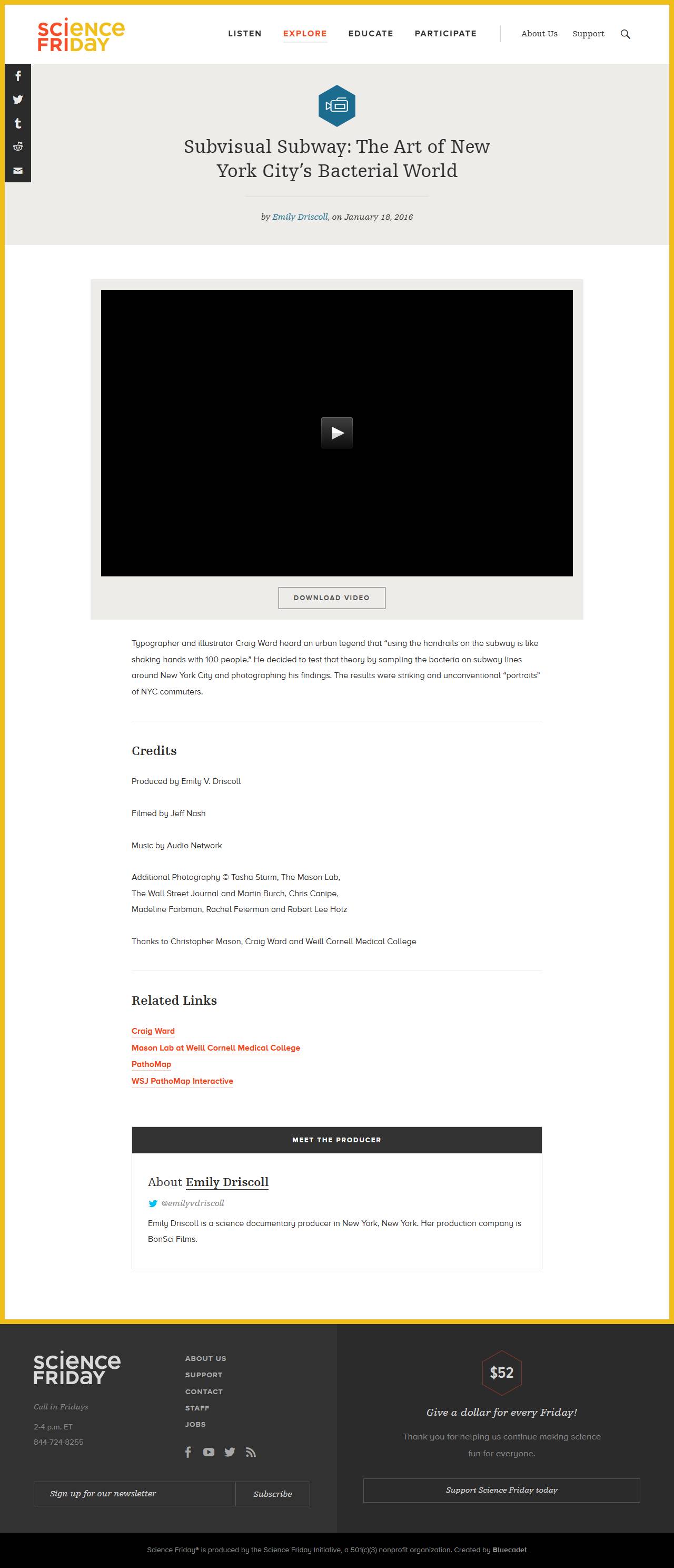
Science Friday2015Subvisual Subway: The Art of New York City's Bacterial WorldVideo

Science Friday video about an artist who sampled subway bacteria to test the handrail-handshake legend and photographed the cultures; it credits the Mason Lab, PathoMap and MetaSUB.

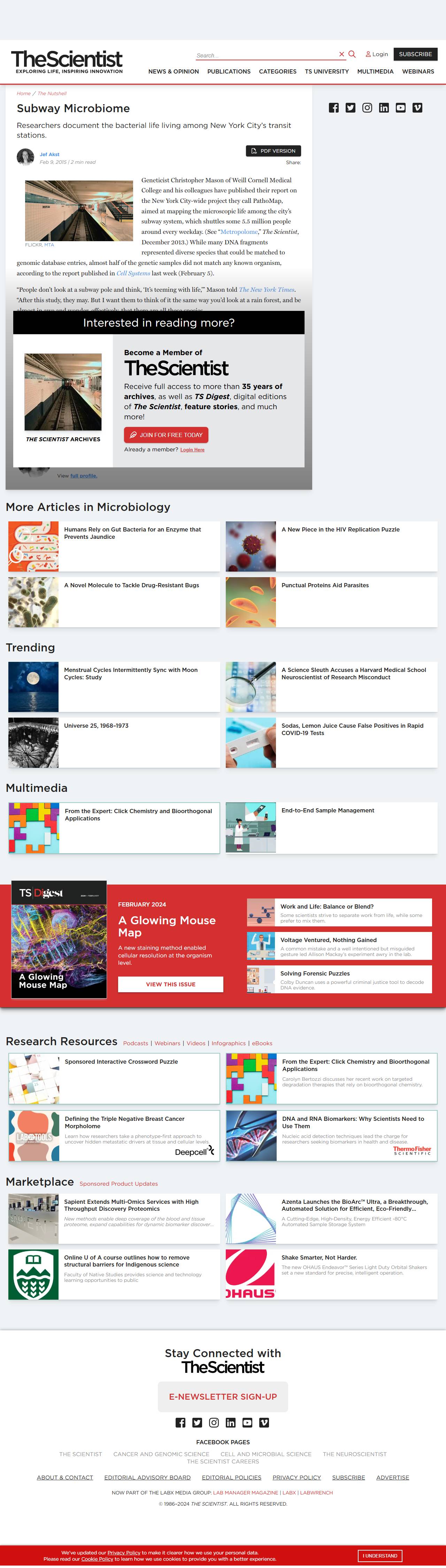
The ScientistFeb 2015Subway Microbiome

Briefly reports the PathoMap Cell Systems paper on New York subway microbes: 1,400+ samples, over 15,000 species detected, and nearly half of the DNA matching no known organism.

The ScientistDec 2013Metropolome

Profile of the early effort to map New York's subway microbiome, in which students collected over 1,400 samples from 468 stations and found diverse, station-specific bacterial communities.

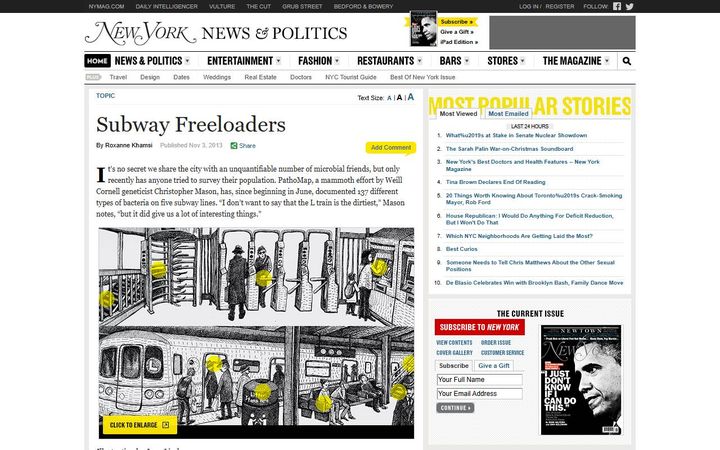
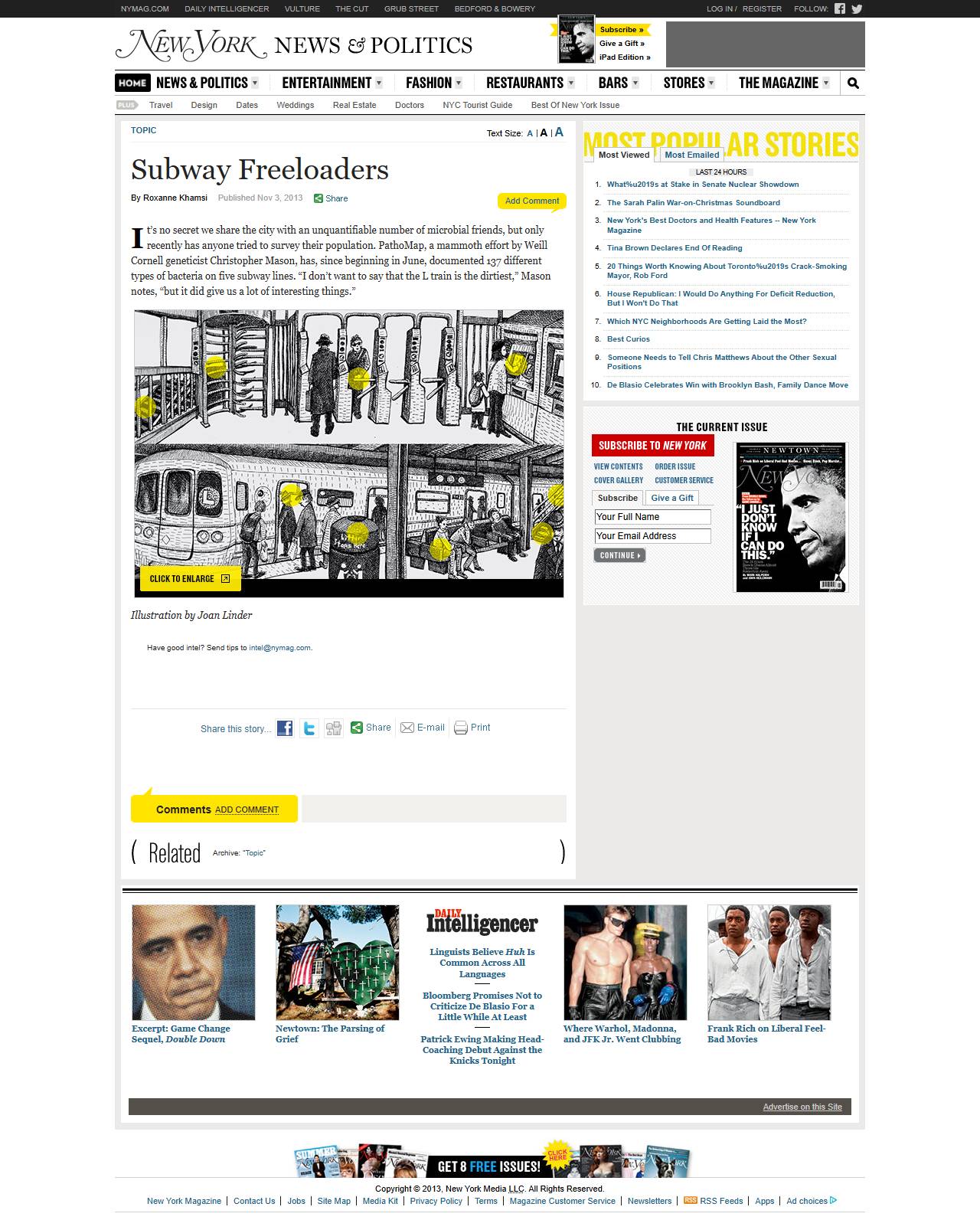
New York MagazineNov 2013A Look at Subway Bacteria

Brief early item on the then-ongoing PathoMap effort, which had logged 137 bacterial types on five subway lines since June, with the lead researcher joking about the L train.

Other work

SPEN & lymphomaCancer Discovery · 2026

SPEN loss drives extra-follicular diffuse large B cell lymphoma with female-specific lethality and therapeutic vulnerabilities

SPEN loss identifies a subset of a common blood cancer that is more lethal in women than in men.

5 items of coverage

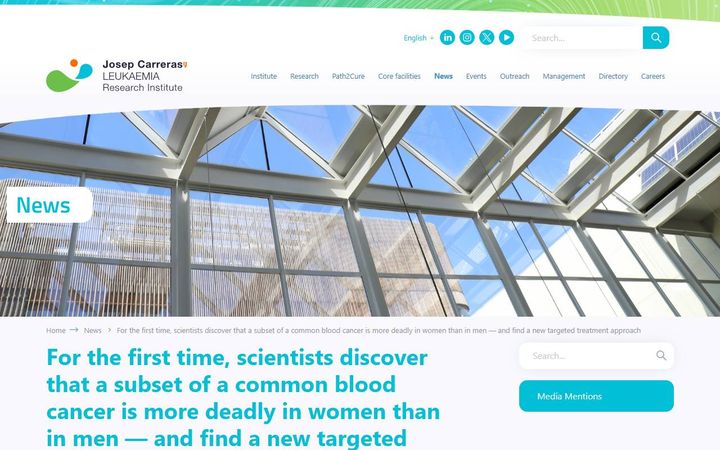
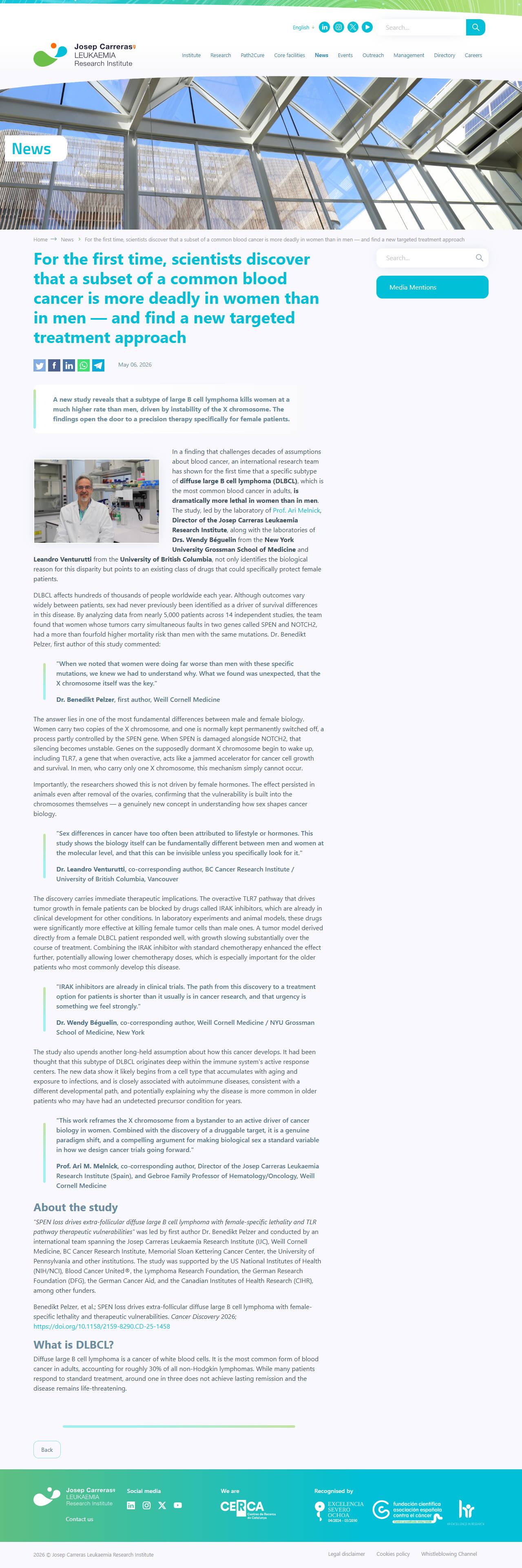
Josep Carreras Leukaemia Research InstituteMay 2026For the first time, scientists discover that a subset of a common blood cancer is more deadly in women than in men — and find a new targeted treatment approachPress release

Institute release on a study finding a DLBCL subtype far deadlier in women than men, explaining the biology behind the disparity and pointing to an existing drug class that may protect female patients.

EurekAlert! (AAAS)May 2026For the first time, scientists discover that a subset of a common blood cancer is more deadly in women than in menPress release

Release on the Cancer Discovery study finding that a SPEN-defined subset of diffuse large B cell lymphoma is more lethal in women than in men, and pointing to a targeted treatment approach.

ReadSaved: HTML
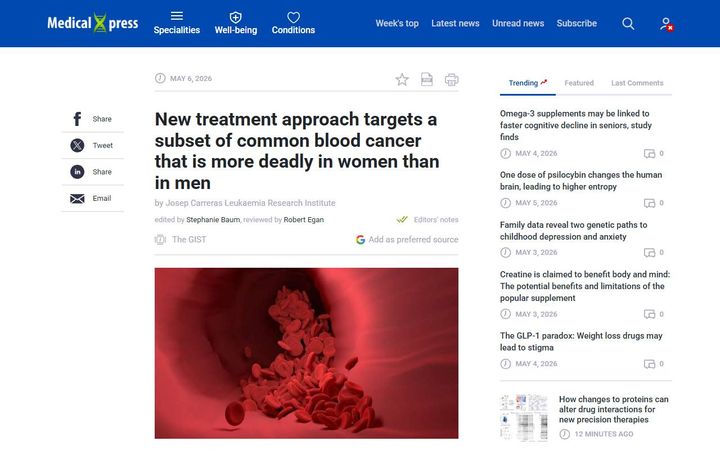
Medical XpressMay 2026New treatment approach targets a subset of common blood cancer that is more deadly in women

Republished institute release reporting that a DLBCL subtype is dramatically more lethal in women, challenging long-held assumptions and indicating a targeted treatment approach.

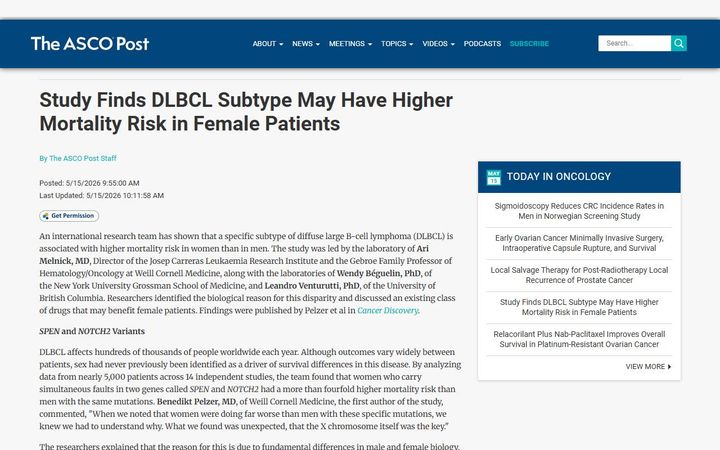
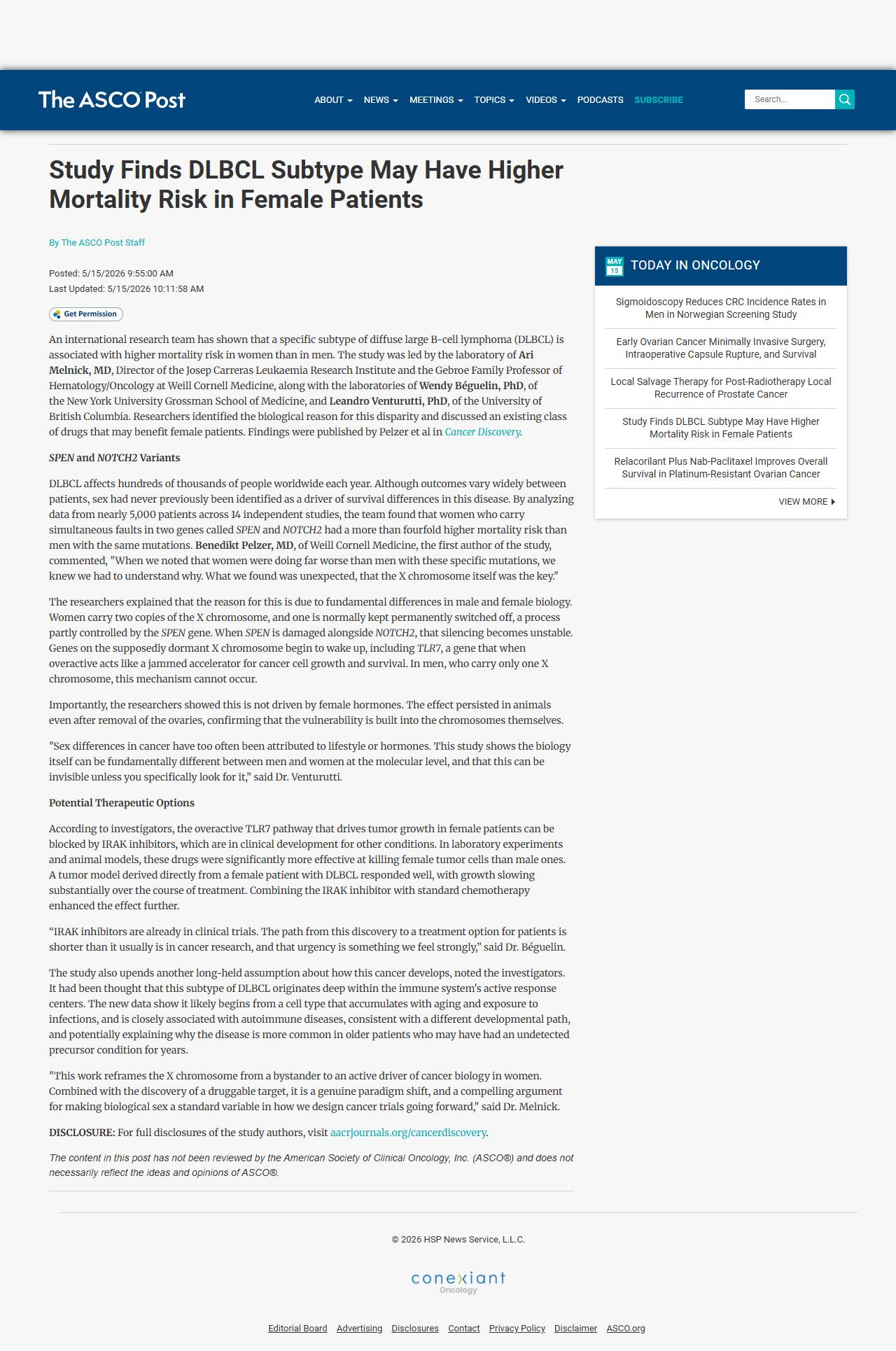
The ASCO PostMay 2026Study Finds DLBCL Subtype May Have Higher Mortality Risk in Female Patients

Oncology news item on a Cancer Discovery study associating a DLBCL subtype with higher mortality in women, with the biological cause identified and an existing drug class suggested as helpful.

HealthTree FoundationJun 1, 2026Study Finds Higher Risks for Some Women with DLBCL

Patient-oriented summary of a Cancer Discovery study of nearly 5,000 patients: women with both SPEN and NOTCH2 changes in BN2-DLBCL had over four times the mortality risk of men, suggesting a treatment target.

10 items of coverage

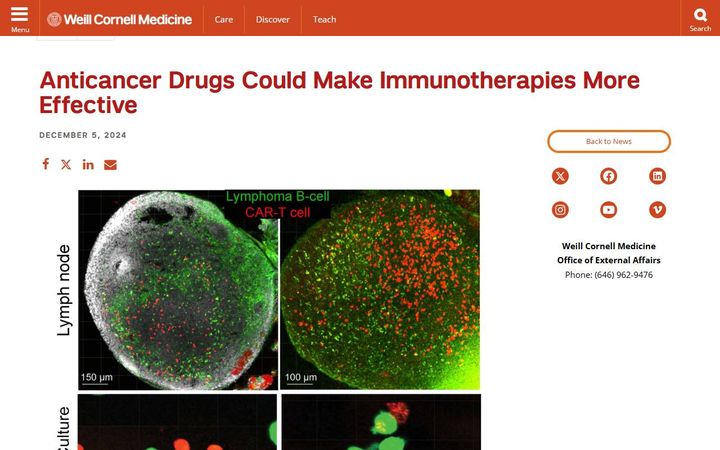
Weill Cornell MedicineDec 5, 2024Anticancer Drugs Could Make Immunotherapies More EffectivePress release

Release on a preclinical Cancer Cell study in which EZH2 inhibitors combined with T-cell immunotherapy shrank B-cell lymphomas better than immunotherapy alone; pilot patient studies have begun.

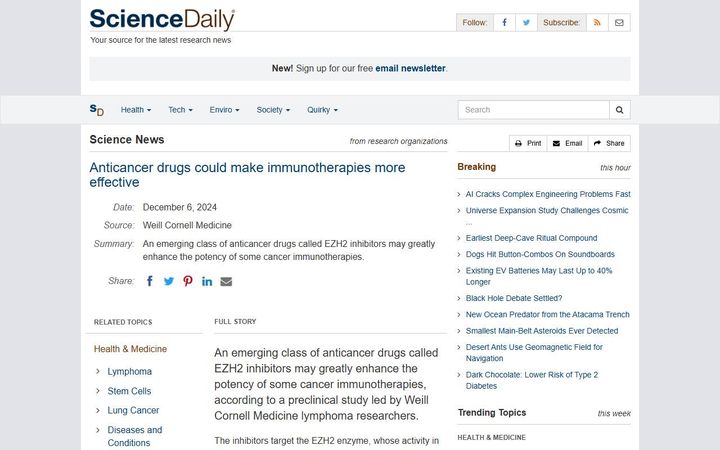
ScienceDailyDec 5, 2024Anticancer drugs could make immunotherapies more effective

Reposted release reporting a preclinical Cancer Cell study that EZH2 inhibition boosts the effectiveness of T-cell immunotherapy against B-cell lymphomas, prompting pilot trials.

News-MedicalDec 5, 2024EZH2 inhibitors enhance effectiveness of cancer immunotherapies

Reports a preclinical study showing EZH2 inhibitors can substantially strengthen T-cell based immunotherapy against non-Hodgkin B-cell lymphomas, with pilot clinical studies starting.

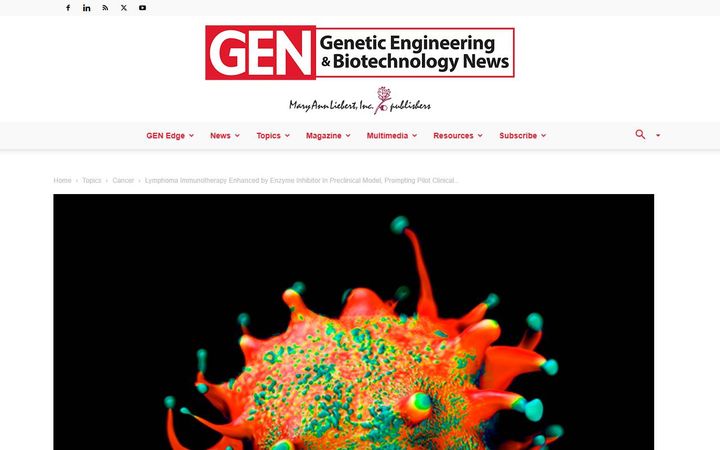
GEN (Genetic Engineering & Biotechnology News)Dec 2024Lymphoma Immunotherapy Enhanced by Enzyme Inhibitor in Preclinical Model, Prompting Pilot Clinical Studies

Biotech news coverage of mouse-model work indicating EZH2 inhibition makes T-cell immunotherapy more effective against B-cell non-Hodgkin lymphoma, leading to pilot clinical studies.

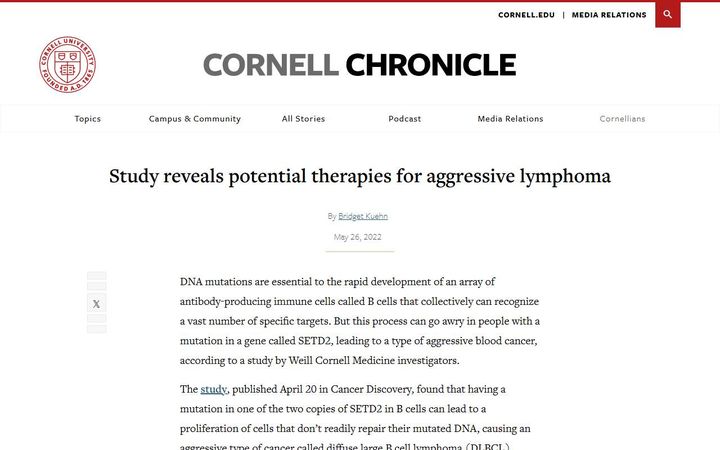
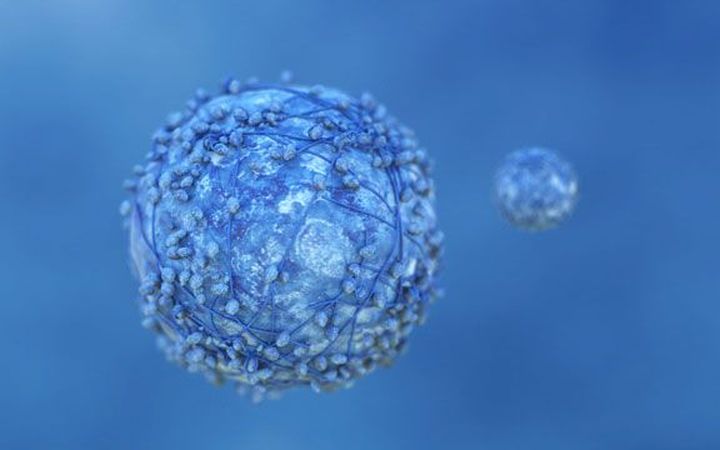
ScienceDailyMay 25, 2022Study reveals cause, potential precision therapies for aggressive type of lymphoma

ScienceDaily carries the release on how a partial SETD2 mutation leads to aggressive B-cell lymphoma and why drugs hitting SETD2 might work, with relevance for patients of African ancestry.

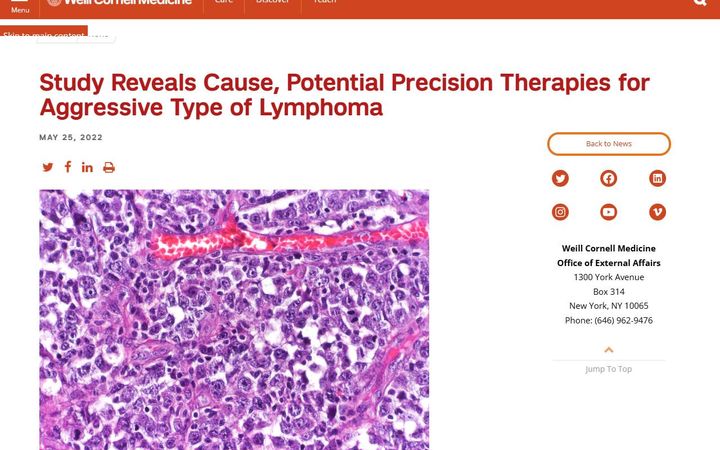
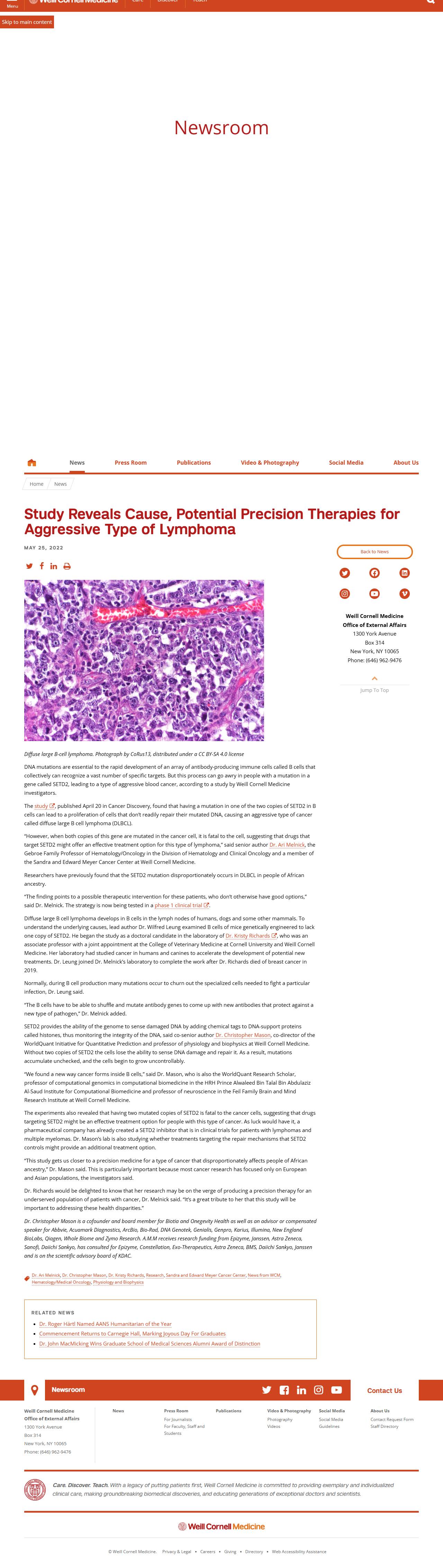
Weill Cornell MedicineMay 2022Study Reveals Cause, Potential Precision Therapies for Aggressive Type of LymphomaPress release

Weill Cornell release on a Cancer Discovery study showing one-copy SETD2 mutation in B cells impairs DNA repair and promotes aggressive diffuse large B-cell lymphoma, whereas losing both copies kills cells, pointing to SETD2-targeted therapy.

Cornell ChronicleMay 2022Study reveals potential therapies for aggressive lymphomaPress release

Cornell Chronicle repost of the release on SETD2 mutations driving aggressive diffuse large B-cell lymphoma and suggesting precision treatment, notably for patients of African ancestry.

Technology NetworksMay 2022New Genetic Cause of Aggressive B Cell Lymphoma Revealed

Technology Networks republishes the release on SETD2 mutation causing aggressive B-cell lymphoma and suggesting targeted therapy options.

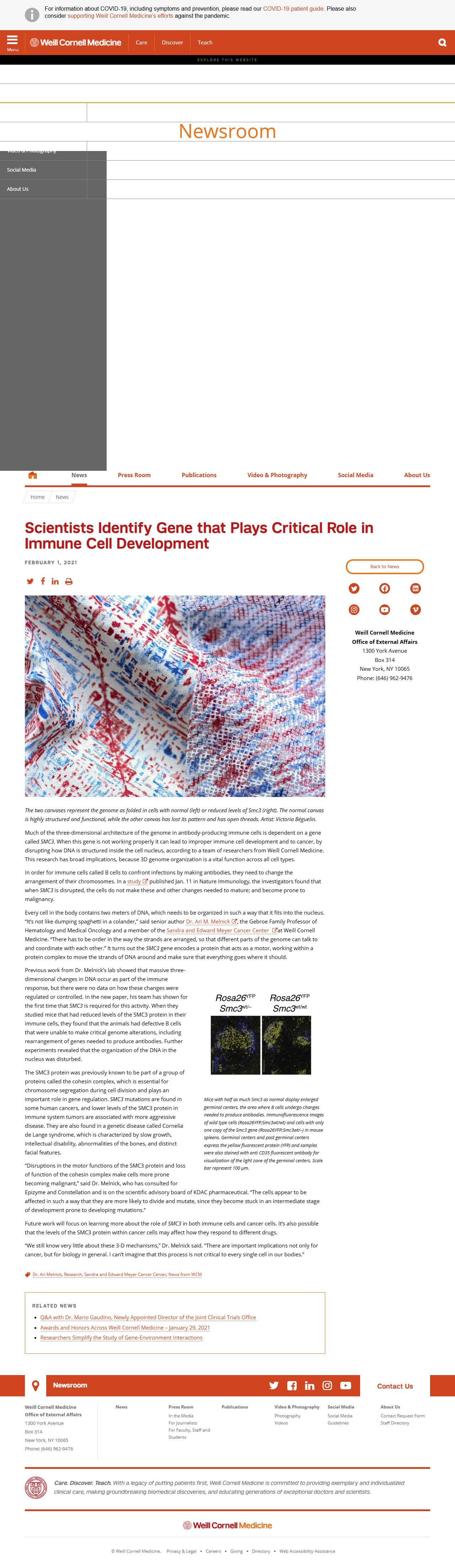
Weill Cornell MedicineFeb 2021Scientists Identify Gene that Plays Critical Role in Immune Cell DevelopmentPress release

Release on a Nature Immunology study showing that SMC3 underpins the 3D genome architecture of antibody-producing B cells, and that its disruption impairs immune cell development and can lead to cancer.

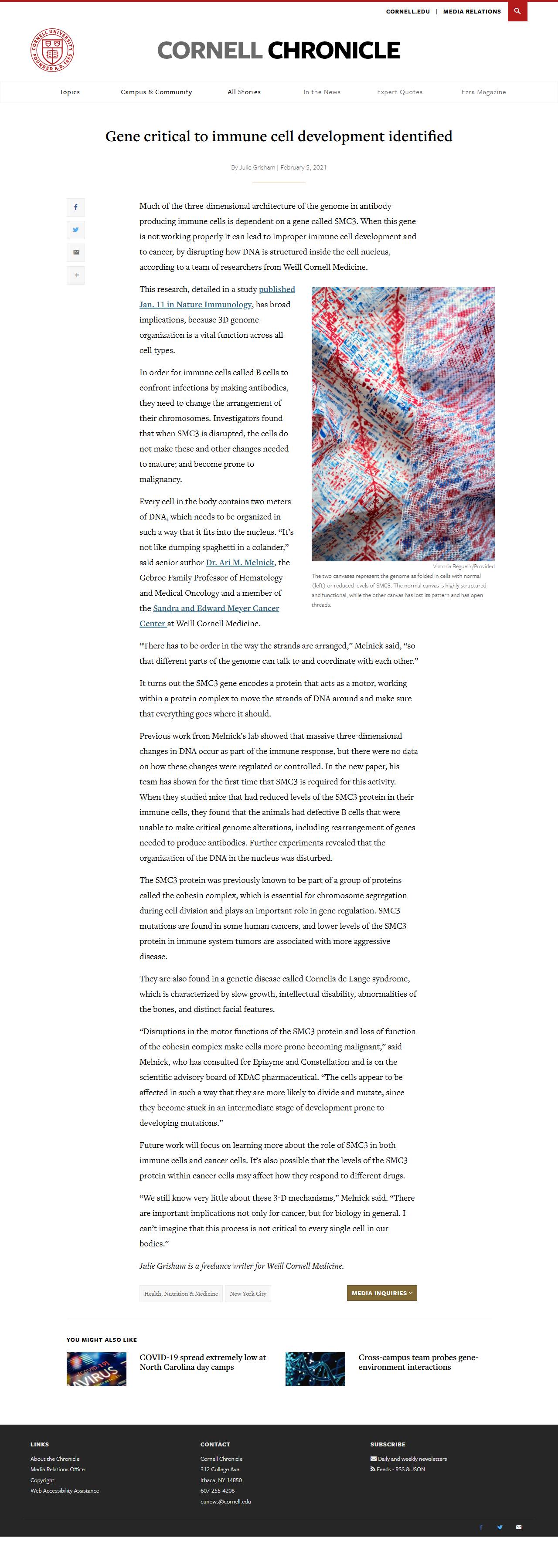
Cornell ChronicleFeb 2021Gene critical to immune cell development identifiedPress release

University story on a Nature Immunology study finding that SMC3 is needed for genome folding in B cells; faulty SMC3 disrupts immune development and can promote cancer.

Global urban microbiomeCell · 2021

Global Genetic Cartography of Urban Metagenomes and Anti-Microbial Resistance

The International MetaSUB Consortium's global atlas of urban microbiomes and antimicrobial resistance across 60 cities.

10 items of coverage

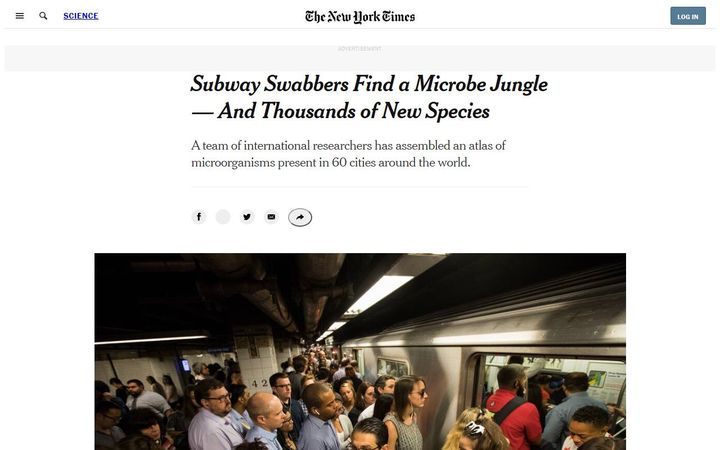
The New York TimesMay 26, 2021Subway Swabbers Find a Microbe Jungle and Thousands of New Species

Covers the Cell paper from the MetaSUB consortium, an atlas of microbes from 60 cities on six continents built by 900-plus contributors, revealing a shared core urban microbiome and over 10,000 previously unknown viruses and bacteria.

WIRED (video)Jul 2021What Doctors Learned from Swabbing Subways in Different CountriesVideo

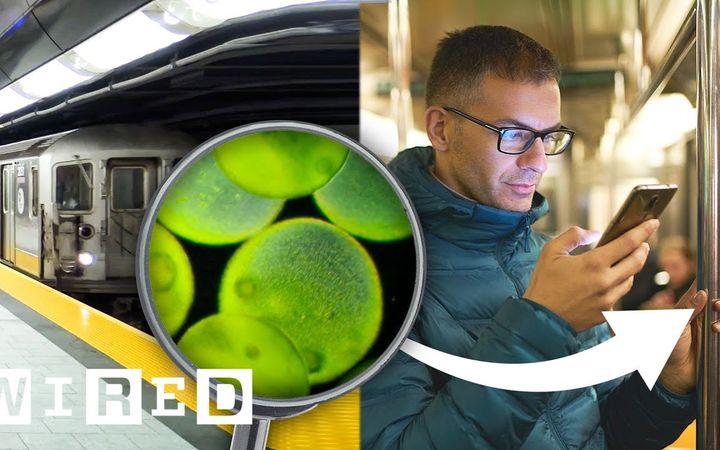
WIRED video on what lives on subway poles, turnstiles and seats: Christopher Mason's team swabbed every New York station and many around the world to map the microbes that travel with passengers.

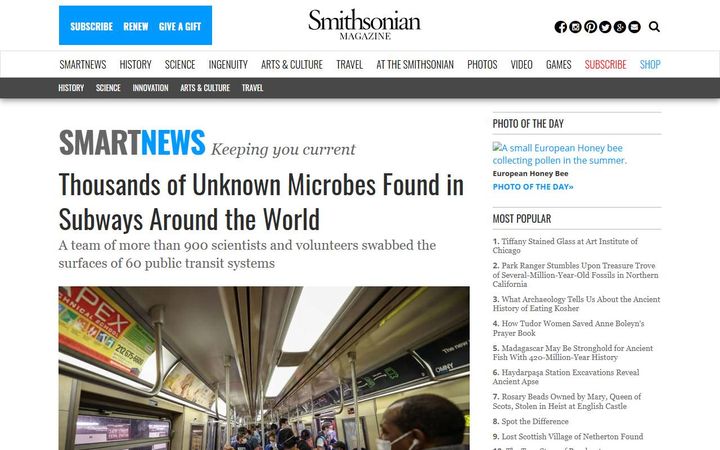
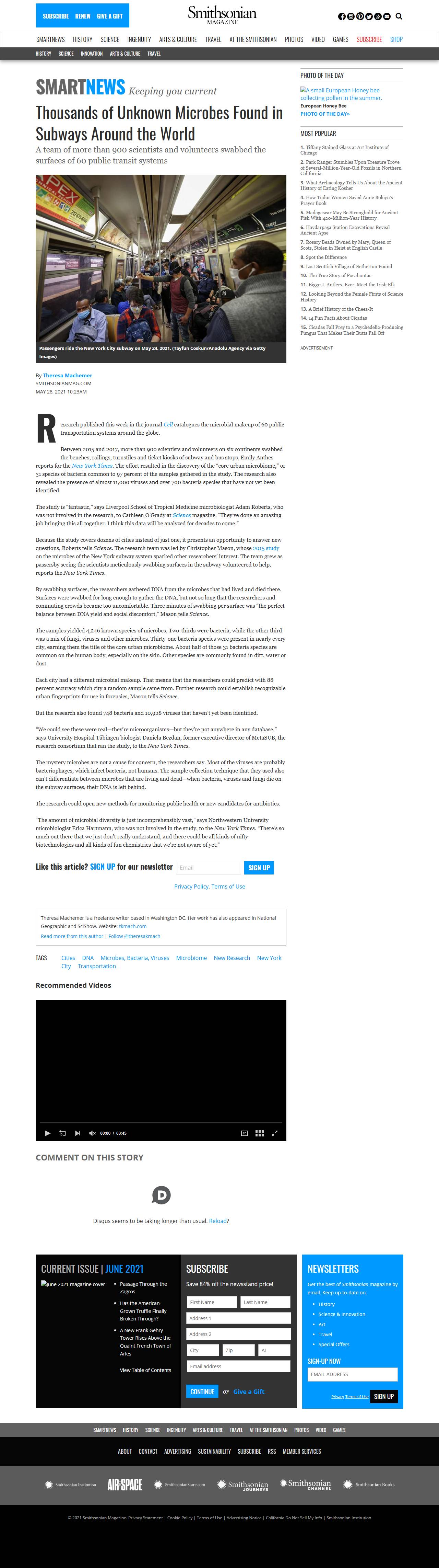
Smithsonian MagazineMay 2021Thousands of Unknown Microbes Found in Subways Around the World

Summarizes the Cell MetaSUB study of 60 transit systems, which found a core urban microbiome of 31 shared bacterial species and thousands of unidentified viruses and bacteria.

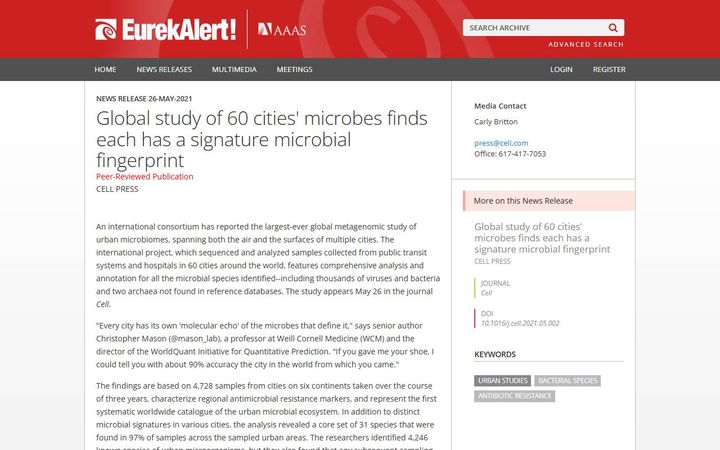
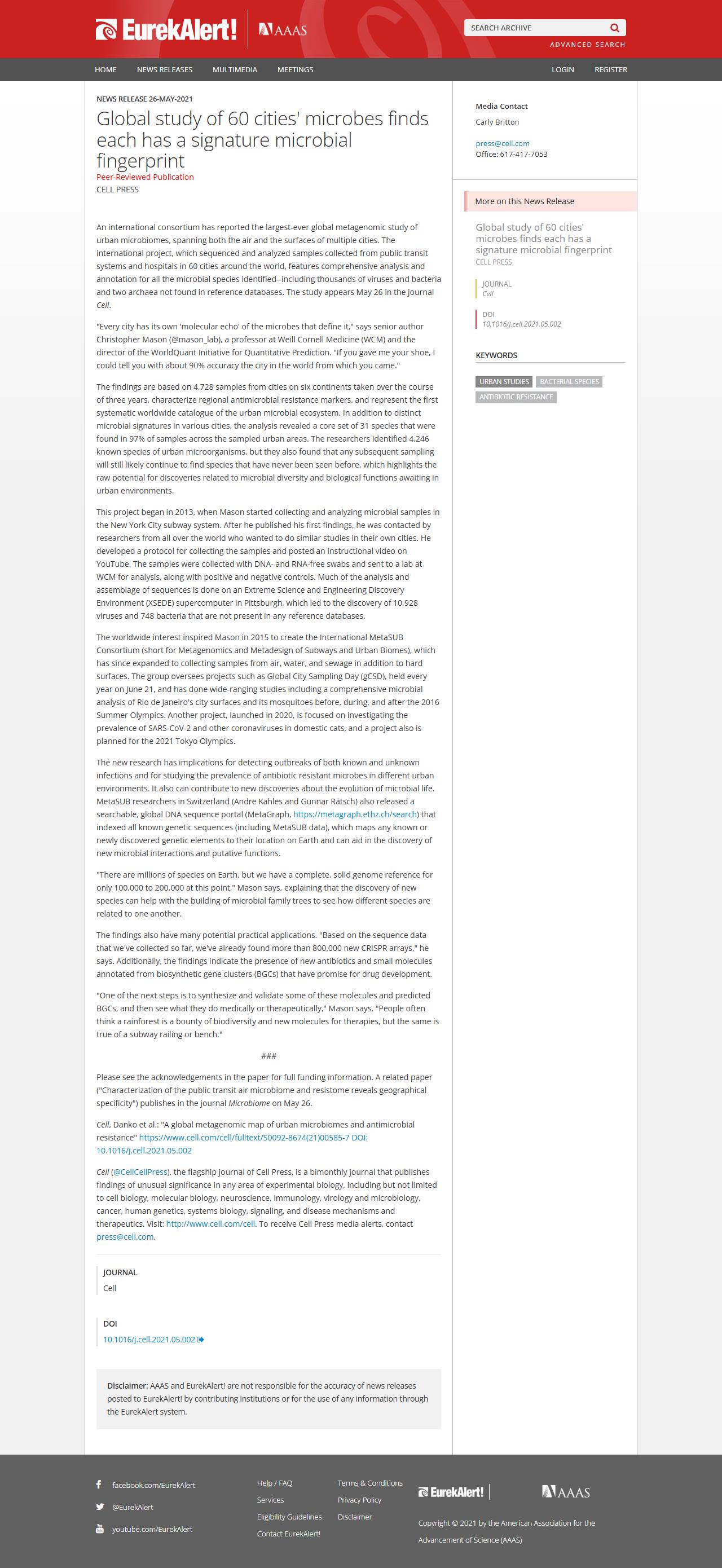
Cell Press (EurekAlert!)May 26, 2021Global study of 60 cities' microbes finds each has a signature microbial fingerprintPress release

Release on the largest global urban metagenomics study, sampling transit systems and hospitals in 60 cities, finding each city has a distinct microbial signature and cataloguing many unreferenced species.

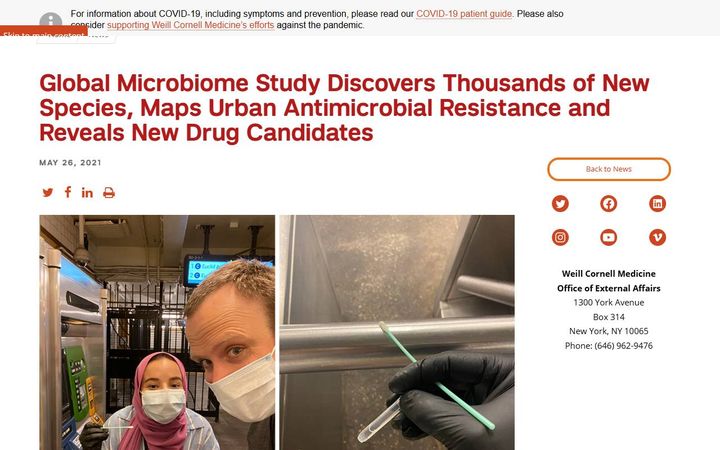
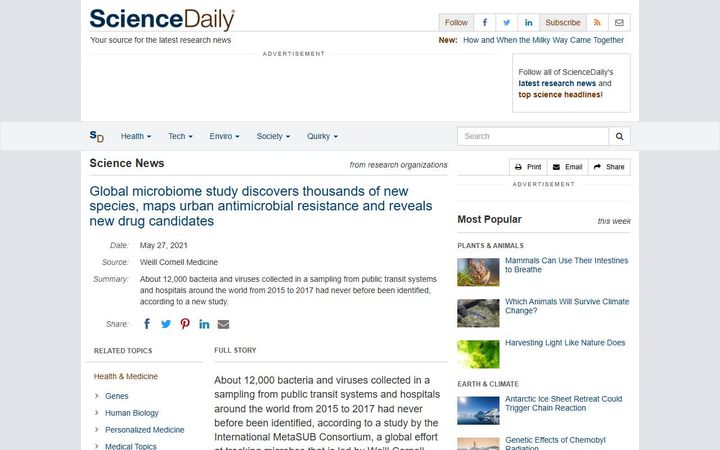
Weill Cornell MedicineMay 2021Global Microbiome Study Discovers Thousands of New Species, Maps Urban Antimicrobial ResistancePress release

Weill Cornell release on the Cell MetaSUB study: about 12,000 unseen bacteria and viruses across 60 cities, urban antimicrobial resistance maps, and new drug candidates.

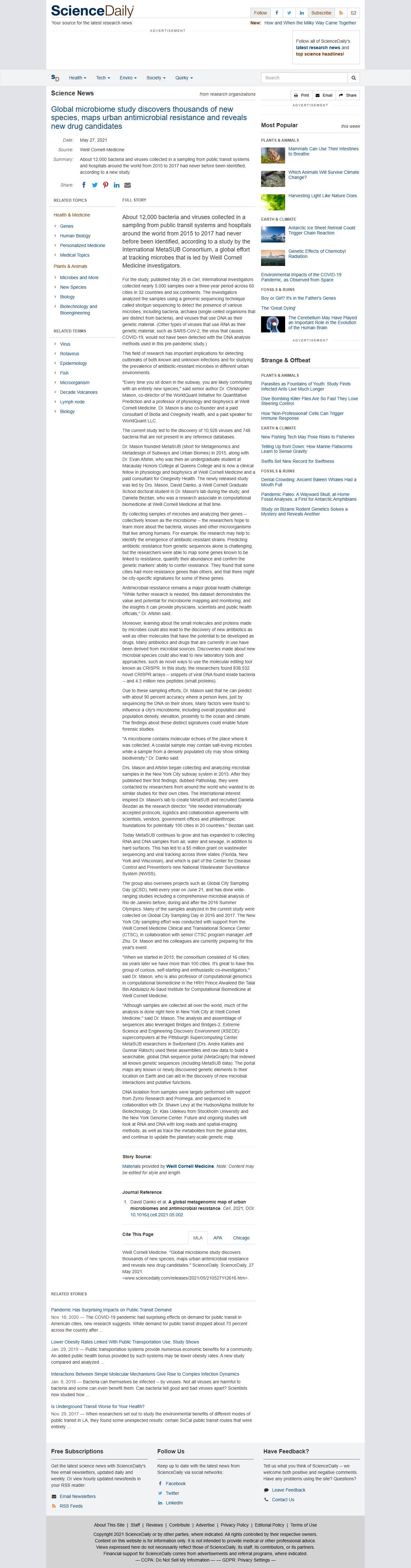
ScienceDailyMay 27, 2021Global microbiome study discovers thousands of new species, maps urban antimicrobial resistance and reveals new drug candidates

Reports that about 12,000 previously unknown bacteria and viruses were found in nearly 5,000 samples from 60 cities in 32 countries by the MetaSUB Consortium in a Cell study.

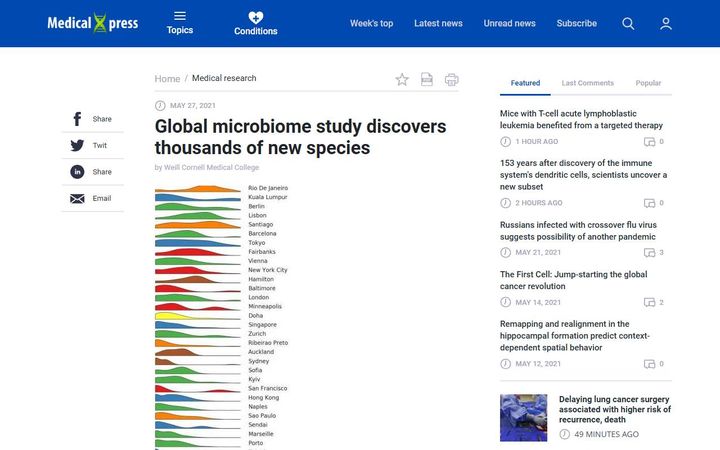
Medical XpressMay 2021Global microbiome study discovers thousands of new species

Reports that about 12,000 previously unknown bacteria and viruses turned up in nearly 5,000 samples from 60 cities across 32 countries, in a Cell study by the MetaSUB Consortium.

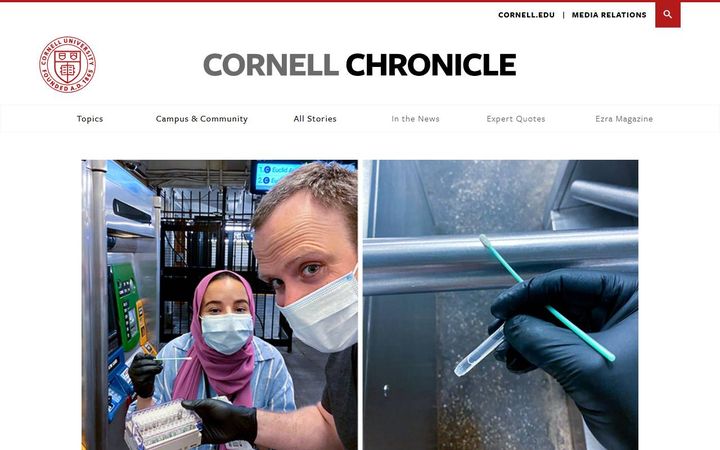
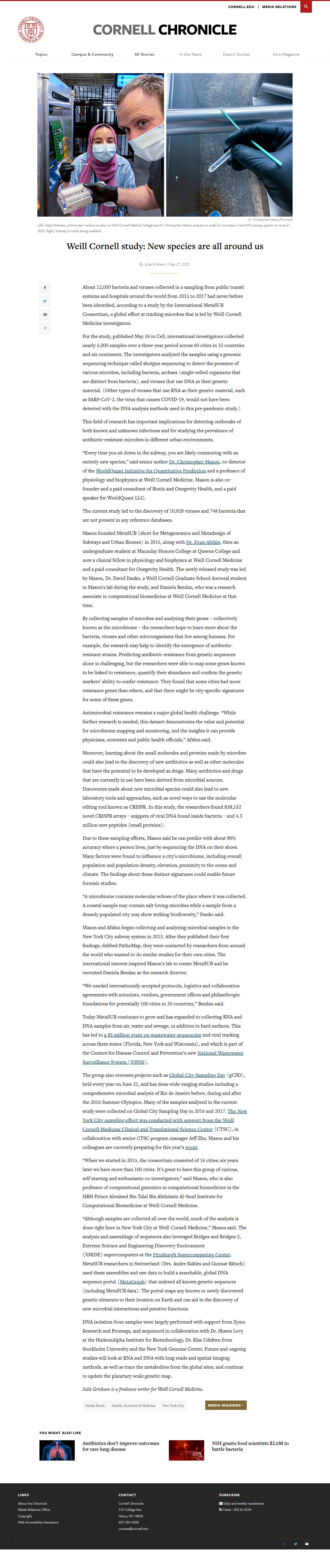
Cornell ChronicleMay 2021Weill Cornell study: New species are all around usPress release

Reports an international MetaSUB Consortium study in Cell that sampled transit systems and hospitals in 60 cities, finding roughly 12,000 previously unknown bacteria and viruses and mapping urban antimicrobial resistance, with implications for outbreak surveillance.

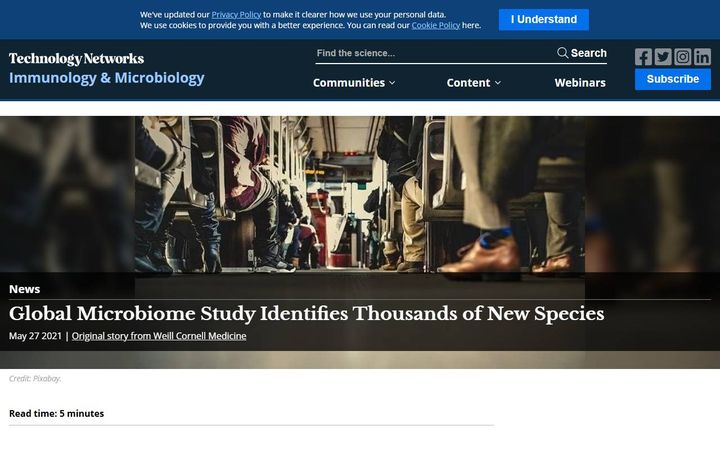
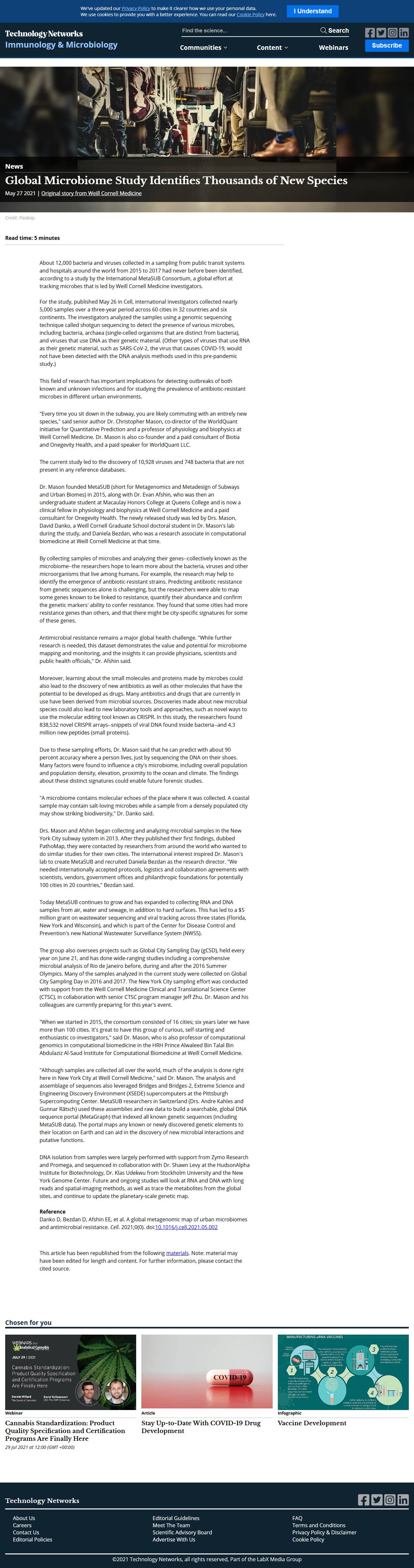
Technology NetworksMay 2021Global Microbiome Study Identifies Thousands of New Species

Reports an international MetaSUB Consortium study in Cell that sampled transit systems and hospitals in 60 cities, finding roughly 12,000 previously unknown bacteria and viruses and mapping urban antimicrobial resistance, with implications for outbreak surveillance.

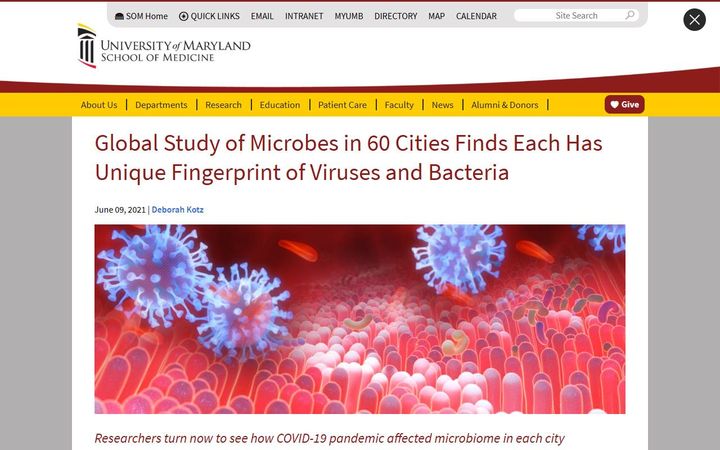
University of Maryland School of MedicineMay 2021Global study of microbes in 60 cities finds each has unique fingerprint of viruses and bacteriaPress release

University of Maryland release on the Cell MetaSUB paper, the largest global urban metagenomic survey to date. It says each city has a distinct microbial fingerprint and highlights the Baltimore sampling led by a UMSOM co-author.

Telomeres & Mt. EverestCell Reports · 2020

Telomere Length Dynamics and DNA Damage Responses Associated with Long-Duration Spaceflight

Telomere length and DNA-damage responses in NASA Twins Study and other astronauts, compared with twin climbers on Mt. Everest, also part of the Biology of Spaceflight collection.

7 items of coverage

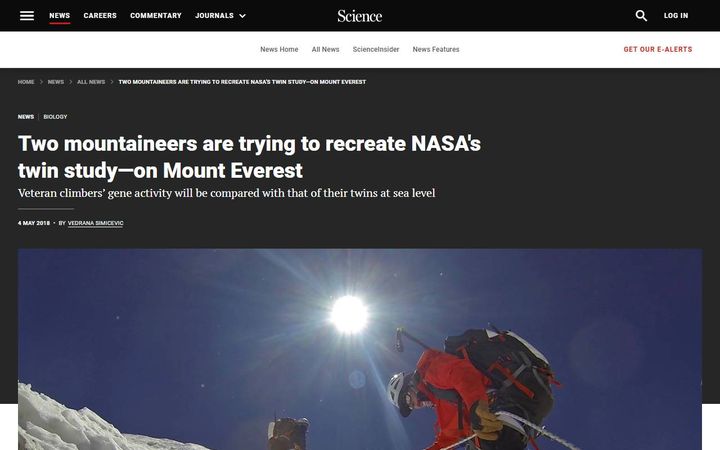
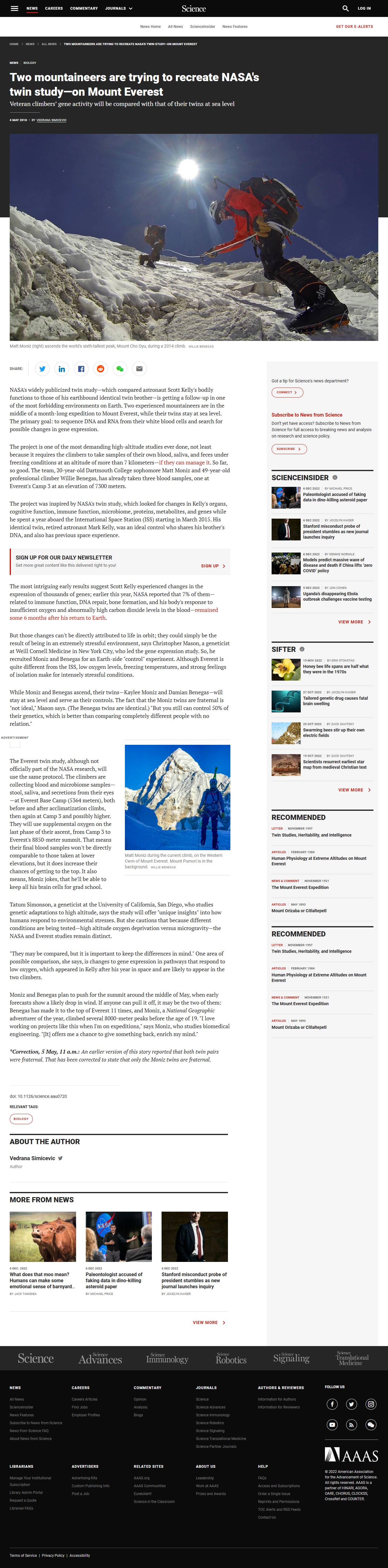
Science2018Two mountaineers are trying to recreate NASA's twin study—on Mount Everest

Science news item on two climbers on Everest, each with a twin at sea level, sampling blood, saliva and stool to sequence DNA and RNA for gene expression changes, as a high-altitude echo of the NASA Twins Study.

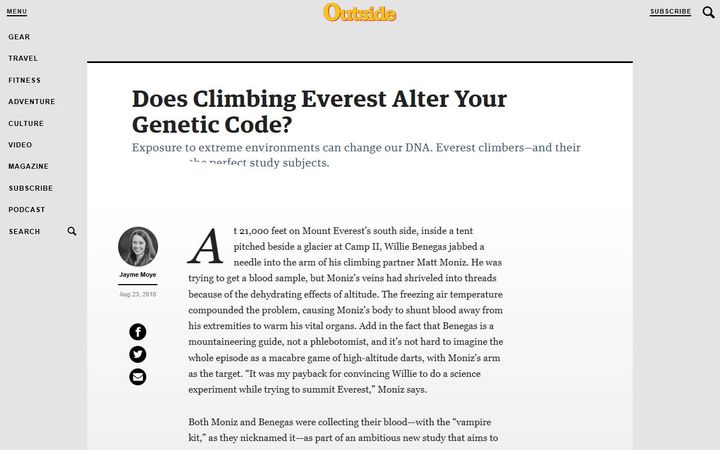
Outside2018Does Climbing Everest Alter Your Genetic Code?

Outside magazine feature on two climbers collecting their own blood on Everest for a study of genetic changes at extreme altitude, using their twins as controls.

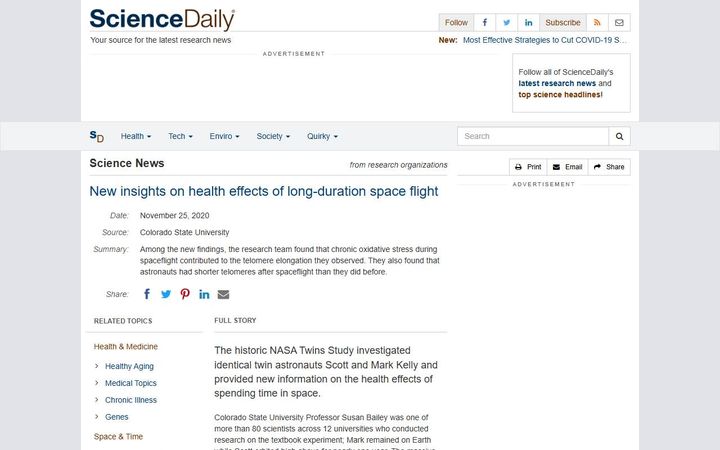
ScienceDailyNov 25, 2020New insights on health effects of long-duration space flight

ScienceDaily repost of the Colorado State release on the 30-paper spaceflight package and telomere findings from the NASA Twins Study.

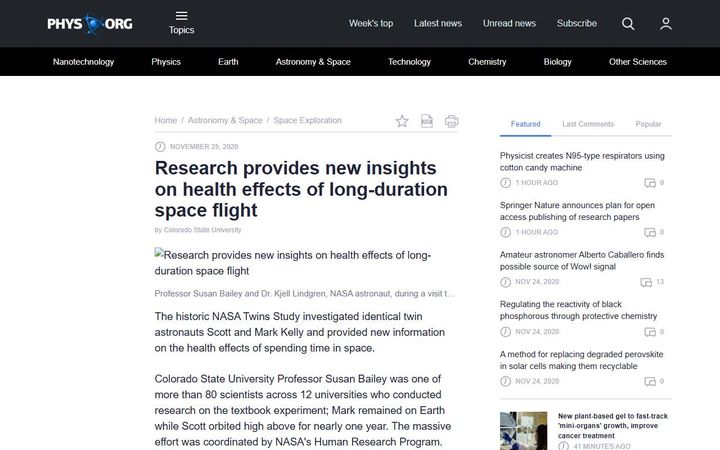
Phys.orgNov 2020Research provides new insights on health effects of long-duration space flight

Phys.org repost of the Colorado State release on the 30-paper spaceflight package and telomere findings from the NASA Twins Study.

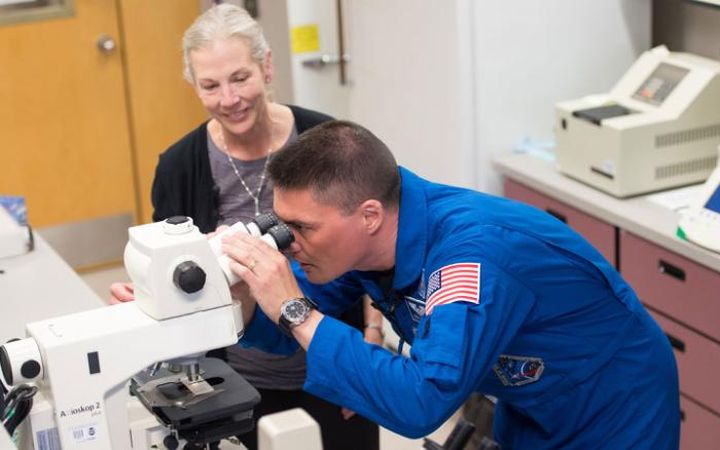
Colorado State UniversityNov 25, 2020Research provides new insights on NASA Twins Study and health effects of long-duration space flightPress release

Colorado State release on a package of 30 papers in Cell Press journals from 200+ investigators, described as the largest space biology and astronaut health dataset, with focus on telomere and DNA damage work by CSU researchers.

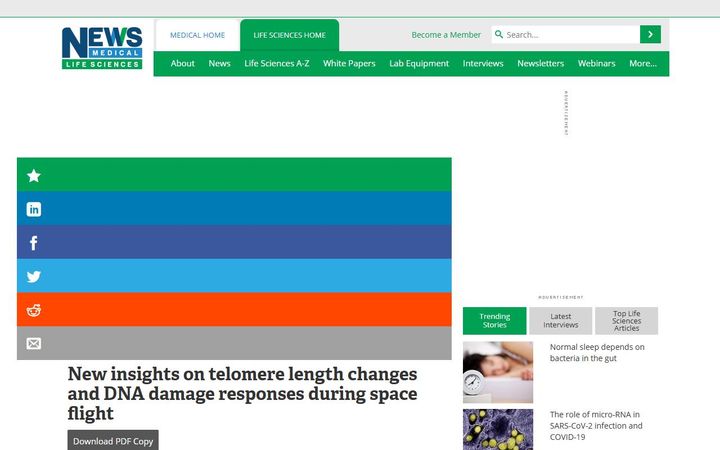
News-MedicalNov 25, 2020New insights on telomere length changes and DNA damage responses during space flight

News-Medical repost of the Colorado State release on telomere length changes and DNA damage responses in spaceflight, within the 30-paper Cell Press package.

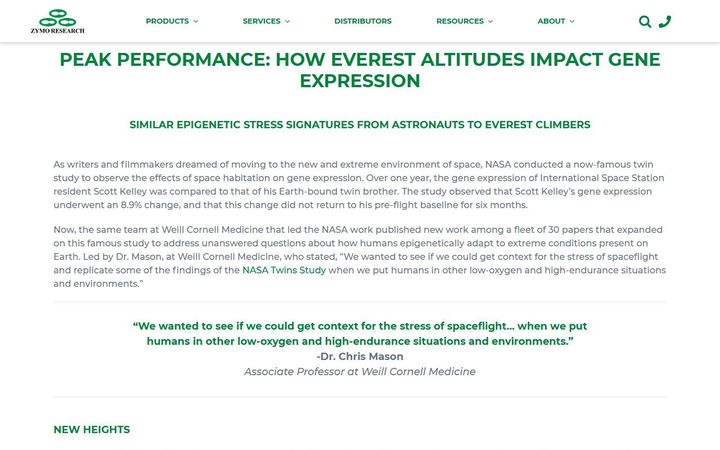
Zymo Research (blog)Peak Performance: How Everest Altitudes Impact Gene Expression

Company blog describing a Weill Cornell follow-up to the NASA twin study in which two Everest climbers, with twins at sea level, were profiled for gene-expression changes under low oxygen.

Summaries are written by the lab and are not the outlets' own words; Turkish-language items are shown with English translations. Quotations keep the affiliations printed at the time. Each entry links to the original story and an archive.org copy where one exists. Saved copies (screenshot, text, HTML) are kept for reference in case a page changes or goes offline. For software and AI agents: media.json (full records, including OCR text of the saved pages), media.md (summaries by study), llms.txt.